
Australia and EU strike free trade deal
Australia and EU strike free trade deal
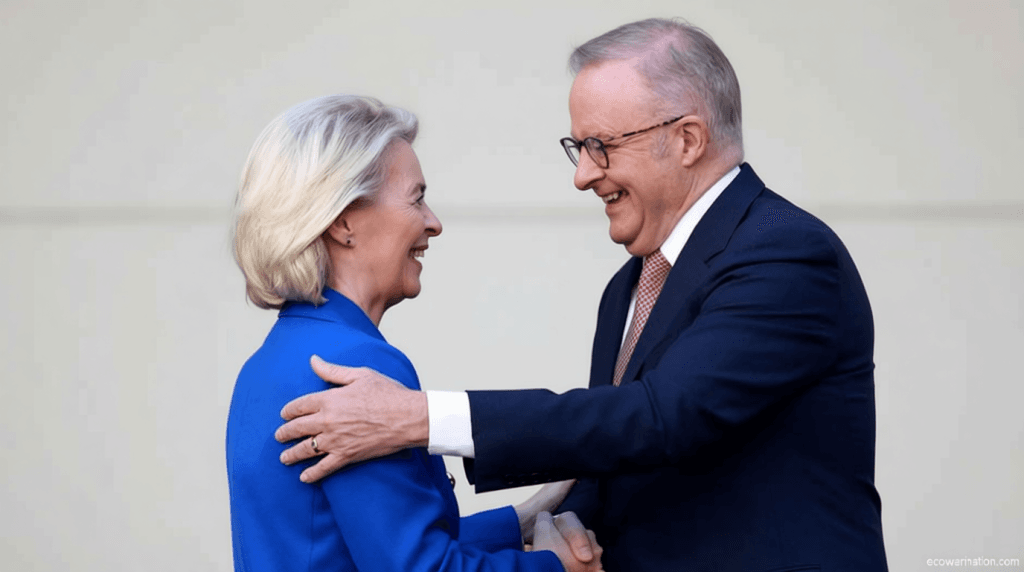
The European Union and Australia have finalized a landmark trade agreement following years of talks, aiming to enhance export opportunities amid shifting global trade dynamics. This pact, announced in Canberra by EU President Ursula von der Leyen and Australian Prime Minister Anthony Albanese, marks a significant milestone in their economic collaboration. It is the EU’s most recent trade deal as it seeks to expand its market reach beyond traditional partners like the United States and China.
Under the terms of the agreement, Australia and the EU will eliminate over 99% of tariffs on goods traded between the two regions, according to AFP. This will save companies an estimated €1 billion annually in import duties. Australian tariffs will be fully removed for wine, sparkling wine, fruits, vegetables, and chocolates immediately, while cheese tariffs will decrease over a three-year period. Meanwhile, European car manufacturers will benefit from Australia’s decision to lower luxury car tax thresholds for electric vehicles, exempting 75% of them from the tax.
The deal also includes provisions for critical minerals, with Australia reducing import tariffs on these resources. A key focus of the negotiations was resolving disputes over product names. The EU had previously restricted Australian producers from using terms like prosecco, parmesan, and feta for locally made goods, as these are protected by EU regulations. However, the agreement allows Australia to retain certain geographical designations for products with a long history of use, such as feta and gruyere, provided they meet specific criteria.
“The EU and Australia may be geographically far apart, but we couldn’t be closer in terms of how we see the world,” von der Leyen remarked during the signing ceremony. “With these new partnerships on security and defense, as well as trade, we are moving even closer together.”
Albanese hailed the agreement as a pivotal achievement for Australia, emphasizing its potential to boost trade and investment. The EU is now Australia’s third-largest trading partner and second-largest source of foreign capital. The pact will be formally ratified after approval by the European Council and Australia’s parliament, with expectations of a swift implementation.
Sticking Points Resolved
Beef exports were a major hurdle in the negotiations. The EU has agreed to open two tariff rate quotas totaling 30,600 tons of Australian beef over five years, with 55% entering duty-free and 45% facing reduced tariffs of 7.5%. This compromise comes after the EU initially sought to grant 50,000 tons of tariff-free access annually, as reported by Australian media. Additionally, the EU will allow a phased 25,000-ton quota of grass-fed sheep and goat meat over seven years.
Trade Minister Don Farrell noted that the deal could add up to 10 billion Australian dollars in annual trade for Australia within the first year. The agreement also establishes a security and defense partnership, underscoring the growing alignment between the two nations in both economic and strategic interests.
