
Hands-On Science Experiments for Students That Spark Curiosity
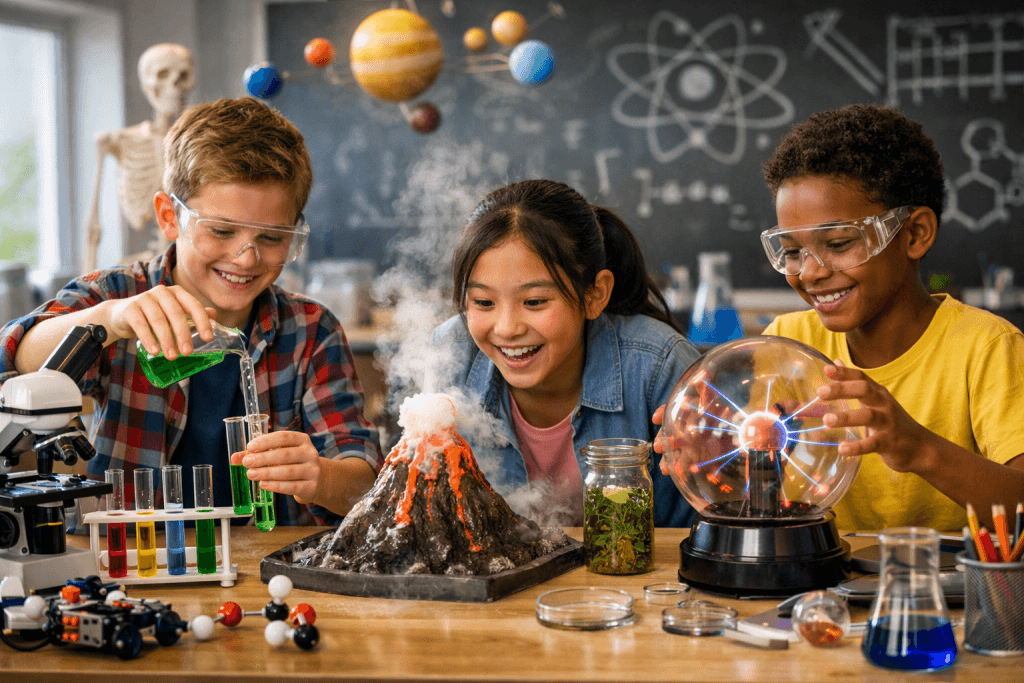
Hands-on learning remains one of the most effective ways to make science meaningful for students. Science experiments for students turn abstract theories into visible, testable outcomes that build understanding through direct experience. When learners observe reactions, measure changes, and test hypotheses themselves, curiosity becomes a natural driver rather than a forced objective. This article presents practical, classroom-ready approaches to hands-on science experiments that consistently spark curiosity and deepen comprehension.
Why Hands-On Science Matters in Education
Hands-on activities help students connect scientific concepts with real-world phenomena. Instead of memorizing formulas or definitions, students see cause-and-effect relationships unfold in front of them. This method improves retention and strengthens critical thinking.
Research-backed teaching practice shows that experiential learning increases engagement across age groups. Science experiments for students also support different learning styles, especially kinesthetic and visual learners. The result is a classroom environment where students participate actively rather than passively receiving information.
Core Principles of Effective Science Experiments
Not all experiments deliver the same educational value. Effective experiments begin with a clear learning objective aligned with curriculum standards. Students should understand what concept is being explored before the experiment starts.
Another essential principle is simplicity. Experiments that use everyday materials reduce barriers and keep the focus on the scientific process. Well-designed science experiments for students emphasize observation, measurement, and reasoning rather than complex procedures.
Physics Experiments That Build Conceptual Thinking
Physics concepts often feel abstract, but hands-on experiments make them tangible. Simple activities like building a balloon-powered car demonstrate Newton’s laws of motion in a visible way. Students can measure distance, speed, and force using basic tools.
Another effective approach involves experiments with light and sound. Using mirrors to explore reflection or rubber bands to test vibration frequency allows students to discover physical principles through trial and error. These science experiments for students encourage analytical thinking while reinforcing mathematical connections.
Chemistry Experiments That Encourage Exploration
Chemistry offers some of the most visually engaging experiments when handled safely. Acid-base reactions using vinegar and baking soda illustrate chemical change in an immediate, observable way. Students learn how substances interact rather than simply reading reaction equations.
Color-change reactions and crystallization experiments also capture attention. These activities help students understand molecular behavior and solution chemistry without advanced equipment. Properly supervised science experiments for students in chemistry promote curiosity while reinforcing lab safety habits.
Biology Experiments That Connect Life and Science
Biology experiments are especially effective when they relate to everyday life. Observing plant growth under different light conditions helps students understand photosynthesis and environmental influence. These experiments unfold over time, teaching patience and data tracking.
Microscope-based activities further strengthen biological understanding. Examining plant cells, water organisms, or human cheek cells brings textbooks to life. Science experiments for students in biology help learners see themselves as part of the natural systems they study.
Earth and Environmental Science Experiments
Earth science experiments help students understand the planet they live on. Creating small-scale models of erosion using soil and water shows how landscapes change over time. Students gain insight into environmental processes that shape ecosystems and communities.
Weather-related experiments also provide practical learning opportunities. Measuring rainfall, tracking temperature changes, or building a simple barometer connects classroom lessons to daily observations. These science experiments for students develop environmental awareness alongside scientific literacy.
Designing Experiments for Different Age Groups
Age-appropriate design is critical for successful hands-on learning. Younger students benefit from experiments with immediate results and simple steps. Activities like floating and sinking tests introduce scientific thinking without overwhelming complexity.
Older students can handle multi-step experiments that require data collection and analysis. Projects involving variables, controls, and written conclusions prepare them for advanced scientific study. Tailored science experiments for students ensure that curiosity grows alongside cognitive ability.
Integrating Inquiry-Based Learning
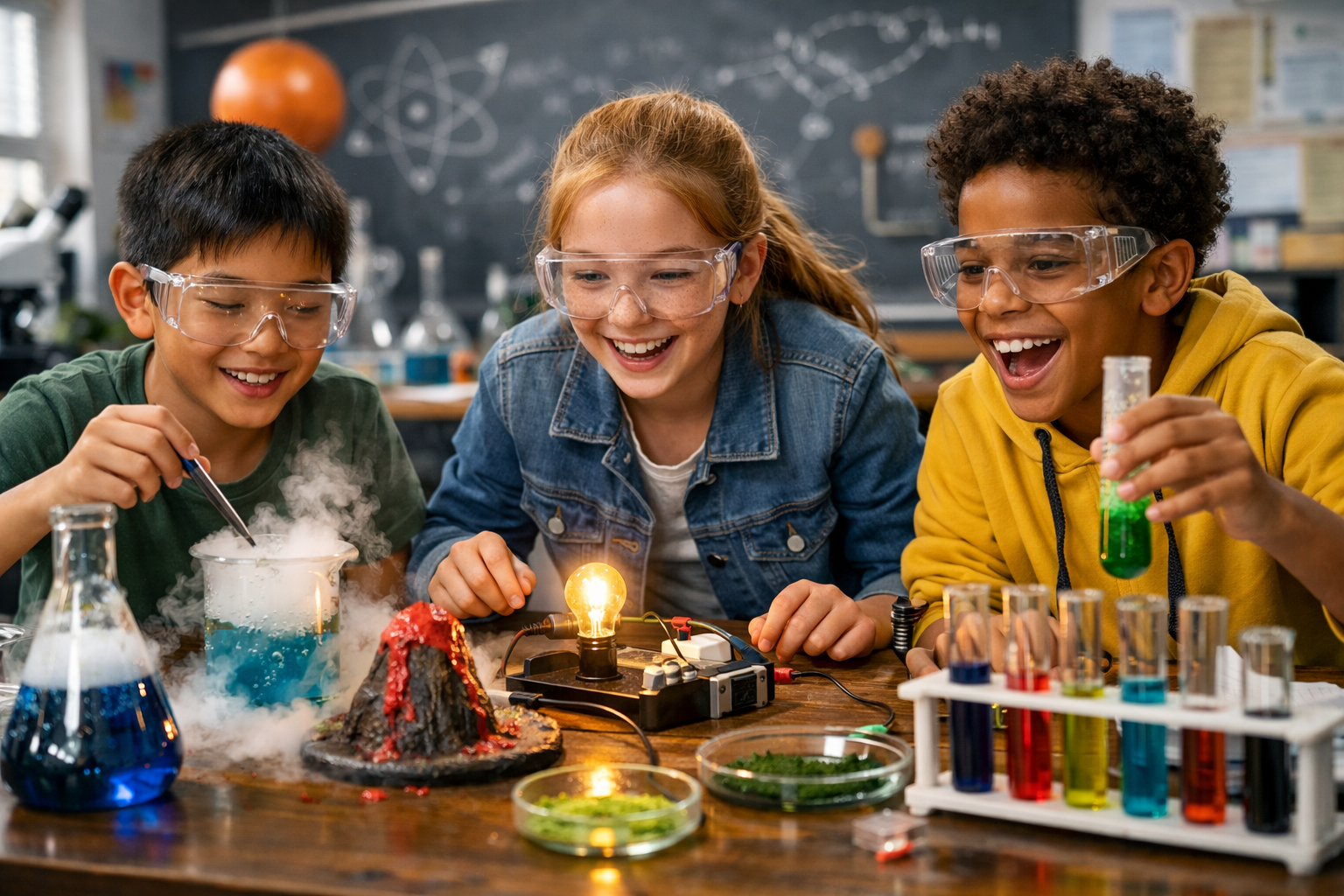
Inquiry-based learning shifts responsibility from teacher to student. Instead of providing all answers, educators guide students to ask questions, form hypotheses, and test ideas. This approach mirrors how real scientists work.
Hands-on experiments are the foundation of inquiry-based classrooms. When students design or modify experiments, they develop ownership of their learning process. Science experiments for students become tools for investigation rather than demonstrations to observe passively.
Safety and Structure in Hands-On Science
Safety is a non-negotiable element of hands-on experimentation. Clear instructions, proper supervision, and age-appropriate materials reduce risk without limiting exploration. Establishing safety routines builds responsibility and discipline.
Structure also matters for learning outcomes. Experiments should follow a logical sequence: question, hypothesis, procedure, observation, and conclusion. Well-structured science experiments for students balance freedom with guidance to maximize educational value.
Measuring Learning Outcomes from Experiments
Assessment should go beyond whether an experiment “worked.” Evaluating student understanding through lab reports, discussions, or presentations reveals deeper learning. Students should explain what happened and why it happened.
Reflection activities help consolidate knowledge. Writing short summaries or comparing predictions with results reinforces scientific reasoning. Through assessment, science experiments for students become measurable contributors to academic progress.
Long-Term Impact of Hands-On Science Learning
Consistent exposure to hands-on experiments builds scientific confidence. Students become comfortable with uncertainty, learning that mistakes are part of discovery. This mindset supports resilience and problem-solving skills beyond science classes.
Over time, students who engage regularly in science experiments for students develop stronger analytical abilities. These skills transfer to other subjects and real-world decision-making. Hands-on science lays a foundation for lifelong curiosity and informed thinking.
Conclusion
Hands-on science experiments transform learning from passive consumption into active discovery. By making concepts visible and testable, science experiments for students spark curiosity, deepen understanding, and build essential thinking skills. When designed with clear objectives, safety, and inquiry in mind, these experiments create lasting educational impact.
FAQ
Q: Why are hands-on science experiments important for students? A: They help students understand concepts through direct experience, improving retention and critical thinking.
Q: What age groups benefit most from science experiments for students? A: All age groups benefit, as experiments can be adapted in complexity to match cognitive development.
Q: Do science experiments for students require expensive equipment? A: No, many effective experiments use simple, everyday materials.
Q: How often should hands-on experiments be used in science classes? A: Regular integration is most effective, especially when aligned with core lesson objectives.
Q: Are hands-on science experiments suitable for large classrooms? A: Yes, with proper structure and grouping, they work well even in large class settings.
