
China’s AI industry looks unstoppable in the race to best US rivals. But is it?
Chinese AI Leaders Weigh Future Prospects at Beijing Meeting
In January, China’s leading artificial intelligence firms convened for a significant gathering in Beijing, sparking discussions on the trajectory of the country’s AI development. A central question emerged: Could a Chinese AI company surpass its American counterparts within the next three to five years?
“Below 20 percent,” said Justin Lin, technical lead for Alibaba’s Qwen AI models. “And I think 20 percent is already very optimistic.”
The cautious outlook contrasted sharply with a year of media coverage highlighting China’s rapid AI growth. Following the surprise emergence of DeepSeek, a lesser-known startup that introduced a high-performing AI model at a lower cost than U.S. alternatives, Chinese firms dominated global model download rankings and secured substantial funding during initial public offerings.
However, amid the celebratory tone, some key developers cautioned that China might be lagging in the development of cutting-edge AI models. Experts cited restricted access to advanced chips and limited capital as persistent hurdles. Tang Jie, founder of Z.ai (Zhipu), echoed this sentiment at the same event.
“The performance gap between Chinese and U.S. models may be widening,” Tang noted. “In some areas we may be doing fairly well, but we also need to acknowledge the challenges and gaps we still face.”
Despite these concerns, China’s AI sector remains dynamic. Challenges in accessing high-performance hardware and funding have driven a distinct strategy—prioritizing open-source AI models. This approach, seen as a way to expedite innovation and challenge U.S. dominance, has led to notable progress across industries.
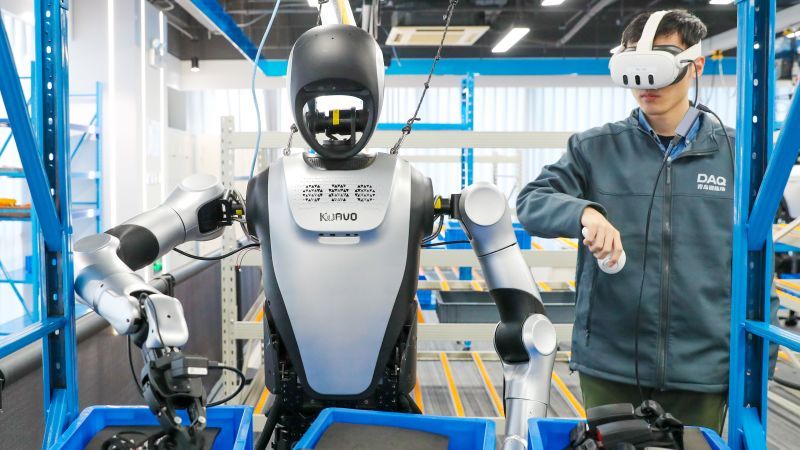
Chinese companies are rapidly deploying AI models in practical applications, integrating the technology into manufacturing, e-commerce, and robotics. In a televised New Year address, Chinese leader Xi Jinping praised the nation’s accelerating innovation, citing AI models “racing ahead” and advancements in domestically developed chips as evidence of Beijing’s push for technological self-reliance.
Qwen, for instance, surpassed Meta’s Llama as the most-downloaded open model on Hugging Face last September. Even global American firms like Airbnb have adopted it for AI-driven customer service. The momentum continued in Hong Kong, where a surge of AI-related listings unfolded. In January, unicorn startups Z.ai and MiniMax, both creators of competitive open-source models, went public, raising $560 million and $620 million respectively, with their share prices rising significantly.
International tech giants are now paying attention. In December, Meta announced its intention to acquire Manus, a Chinese-founded AI agent firm that later moved to Singapore. While the deal has sparked further debate, it underscores the growing influence of China’s AI landscape on the global stage.
