
Yeoh: Meaning, Origin, and Cultural Significance Explained
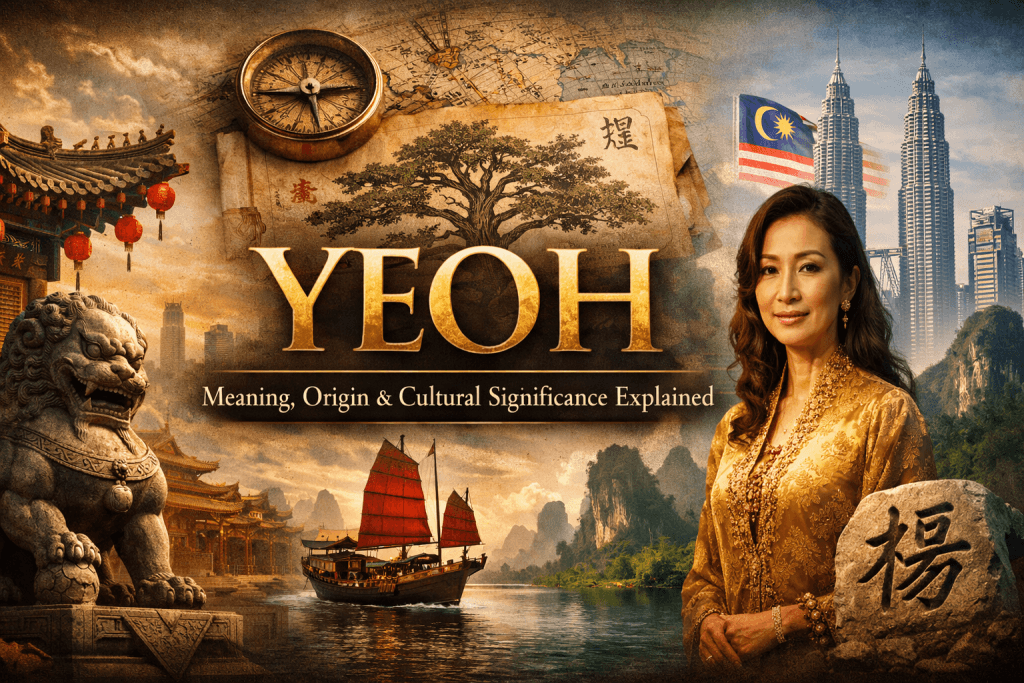
The name yeoh is most widely recognized today as a Chinese surname, especially in Southeast Asia, but its meaning and origin are often misunderstood. In most cases, yeoh is not a separate “new” name with a single dictionary definition. It is a romanized spelling that represents older Chinese characters and regional pronunciations, shaped by migration, colonial-era paperwork, and local language habits.
Because of this, yeoh carries cultural significance beyond literal meaning. It reflects ancestry, dialect identity, and the long history of Chinese communities adapting to new countries while preserving family lineage. Understanding yeoh properly requires looking at Chinese surname traditions, dialect romanization systems, and how the name spread internationally.
What Does “Yeoh” Mean?
In the strictest sense, yeoh does not have one universal meaning by itself. The spelling “Yeoh” is usually a romanization of a Chinese surname written in Chinese characters. Meaning comes from the original character, not from the English spelling.
The most common character associated with yeoh is 杨, which in Mandarin is spelled Yang. The character 杨 historically refers to a type of tree, often translated as poplar or willow-poplar, depending on context. This gives the surname a nature-based origin, which is common in ancient Chinese naming.
However, yeoh can also represent other surnames depending on family history and dialect. This is why two people with the same spelling “Yeoh” might not share the exact same Chinese character, even if both are ethnically Chinese.
Origin of the Yeoh Surname in Chinese History
Chinese surnames are among the oldest continuously used family identifiers in the world. Many major surnames were established thousands of years ago and became associated with clans, regions, and historical states. If yeoh corresponds to 杨 (Yang), its origin is deeply rooted in early Chinese history.
The surname 杨 is traditionally linked to ancient noble lineages and regional states during early dynastic periods. Over time, it spread widely across northern and central China. As populations migrated, the surname became one of the most common in the Chinese-speaking world.
This long history matters because Chinese surnames function as lineage markers, not just personal labels. For many families, keeping the surname consistent across generations is a way to preserve identity, honor ancestors, and maintain clan continuity.
Why “Yeoh” Is Spelled This Way: Dialects and Romanization
The spelling yeoh is strongly associated with Chinese communities in Malaysia, Singapore, and parts of Indonesia, where many Chinese families historically spoke dialects such as Hokkien, Cantonese, Teochew, and Hakka. These dialects pronounce the same Chinese character differently than Mandarin.
Romanization adds another layer. Before standardized systems like Hanyu Pinyin became globally dominant, many Chinese surnames were written in English based on local pronunciation and colonial spelling conventions. British colonial administration in Malaya and Singapore, for example, often recorded names in forms that matched English spelling habits.
This is how a surname like 杨 could appear as “Yeoh” in one region while appearing as “Yang” in another. In some dialects, the initial sound and vowel shift can make “Yang” sound closer to “Yeoh” or “Yeo,” especially when filtered through older romanization habits.
It also explains why you may see multiple spellings that look related: Yeoh, Yeo, Yoh, Yeow, and sometimes even Yo. These variants can represent the same original character, but not always.
Cultural Significance of Yeoh in Southeast Asia
In Southeast Asia, yeoh often carries a distinct cultural identity that goes beyond being a surname. It can signal Chinese diaspora heritage, especially within Peranakan, Straits Chinese, or long-established Chinese-Malaysian and Chinese-Singaporean communities.
Many Chinese families in the region preserved their surnames while adapting to local languages, schooling systems, and national identity structures. The spelling “Yeoh” became part of that adaptation. It is not merely a translation, but a historical artifact of migration and settlement.
This surname is also associated with clan networks and community structures. In many Chinese diaspora settings, surnames connect individuals to clan associations, ancestral temples, and shared origin stories. Even if modern generations no longer speak the original dialect fluently, the surname remains a visible link to family roots.
The cultural weight of yeoh is especially clear when families maintain genealogies, ancestral rites, or traditional naming patterns. In these contexts, the surname functions as a stable identity anchor across countries and generations.

Yeoh in Modern Global Recognition
The surname yeoh has gained broader global visibility in recent decades due to international media and public figures. When a surname becomes globally recognized, it often shifts from being a purely ethnic identifier into a name that carries public cultural symbolism.
For many people outside Asia, “Yeoh” may be their first exposure to a Southeast Asian Chinese surname that is not in standard Mandarin romanization. This creates an important cultural point: Chinese identity is not limited to Mandarin-based spellings. The diaspora includes many dialect communities with distinct linguistic histories.
In multicultural societies, surnames like yeoh also become part of national identity. A person with the surname may be fully Malaysian, Singaporean, Indonesian, British, Australian, or American, while still carrying a surname that reflects Chinese ancestry. This dual identity is common and culturally significant.
Modern usage also shows how surnames travel. Through migration, education, and global careers, the surname yeoh now appears across continents. Its meaning is no longer only tied to one region, but to a broader story of diaspora movement and cultural continuity.
Common Misconceptions About the Name Yeoh
One common misconception is assuming yeoh is a given name. In most cases, it is a family name (surname). Chinese naming order traditionally places the surname first, but in Western contexts, many people reverse it, which can cause confusion.
Another misconception is believing “Yeoh” has a single English meaning like modern baby-name dictionaries suggest. In reality, the meaning depends on the Chinese character behind it. Without the character, “Yeoh” is best understood as a phonetic spelling, not a direct word translation.
Some people also assume that all “Yeoh” families share the same origin. This is not guaranteed. While many may trace back to the same character and broader clan roots, different families could share the spelling due to romanization overlap.
Finally, many assume Mandarin spelling is the “correct” form. That is historically inaccurate for diaspora communities. A surname spelling like yeoh can be just as authentic as “Yang,” because it reflects the dialect and migration context in which the family name was recorded.
Conclusion
Yeoh is best understood as a Chinese surname whose meaning and origin depend on its original Chinese character, most commonly linked to 杨 (Yang), a name historically associated with a tree and a long-standing Chinese lineage. Its cultural significance is especially strong in Southeast Asia, where dialect pronunciation and colonial-era romanization shaped the spelling into the modern form “Yeoh.” More than a name, yeoh reflects ancestry, migration history, and the way identity is preserved across generations and countries.
FAQ
Q: Is yeoh a Chinese surname or a given name? A: In most cases, yeoh is a Chinese surname (family name), not a given name.
Q: What is the most common Chinese character for yeoh? A: The most common character is 杨, which is spelled Yang in Mandarin.
Q: Why do some people spell it “Yeoh” instead of “Yang”? A: The spelling comes from dialect pronunciation and older romanization practices in Southeast Asia.
Q: Are “Yeoh” and “Yeo” the same surname? A: Often yes, but not always; both can represent the same original character depending on family history.
Q: Does yeoh have one exact meaning in English? A: No, the meaning depends on the Chinese character behind the spelling, not the spelling itself.
