

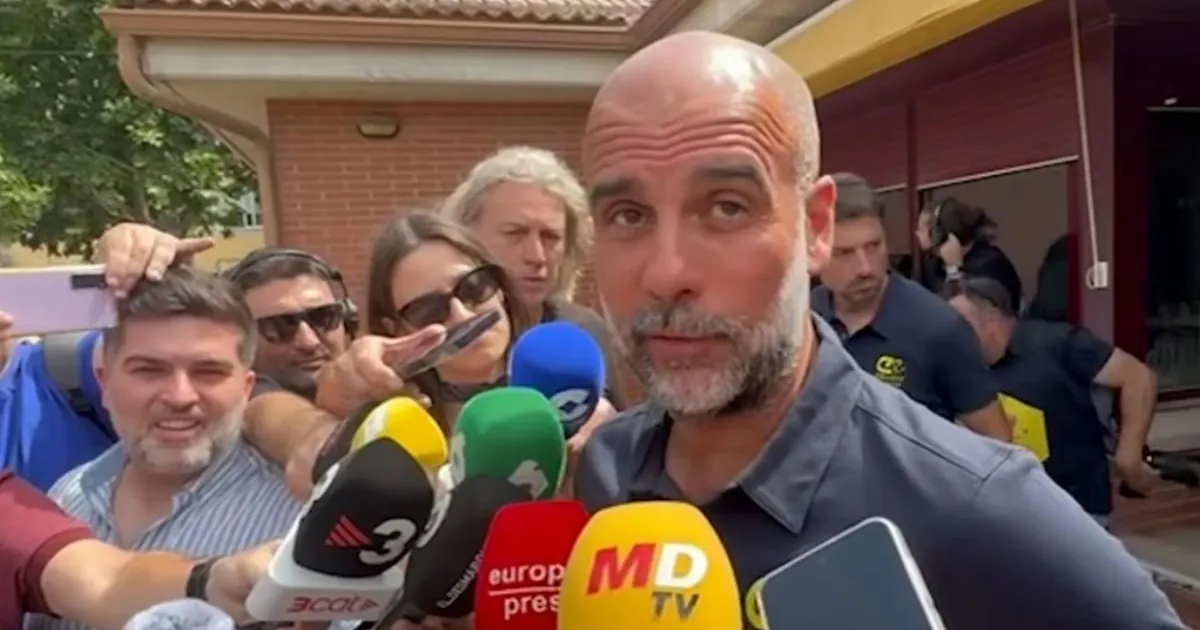
Pep Guardiola Issues Champions League Warning After Arsenal Defeat to PSG
Pep Guardiola issues Champions League warning – Following Arsenal’s surprising loss to Paris Saint-Germain in the Champions League final, Pep Guardiola has taken a critical stance on the tournament’s influence over club success. The former Barcelona and Manchester City manager, who has left his role at Manchester City, emphasized that clubs should not equate triumphs in Europe with overall achievements, suggesting that overemphasis on the competition might undermine long-term stability and development.
Paris Saint-Germain’s victory over Arsenal in last year’s final marked a historic moment for the French club, securing their first-ever Champions League title. This win was followed by a successful defense of the trophy in the subsequent final, which took place in Budapest. The match saw PSG triumph on penalties after a closely contested game, showcasing their resilience and ability to perform under high-pressure scenarios.
Guardiola, who has previously won the Champions League three times, has a deep understanding of the tournament’s challenges. Two of his victories came during his tenure at Barcelona, where he transformed the team into a dominant force. His third title was achieved with Manchester City, a feat that solidified his legacy as one of the most successful managers in European football history. However, his recent comments signal a shift in perspective, prioritizing domestic league performance as a more reliable indicator of a club’s progress.
Speaking after his departure from Manchester City, Guardiola highlighted the contrast between the Champions League and the domestic league. He argued that while the continental competition requires exceptional conditions, including a lack of injuries and favorable officiating, the league serves as a consistent measure of a team’s development. “The league is the competition that establishes the foundation for assessing a season’s value,” he stated, reinforcing his belief that success in the Champions League should not overshadow achievements in the domestic arena.
“The Champions League can destroy projects,” Guardiola remarked. “I hope that doesn’t happen at Barcelona. Winning it is great, but it shouldn’t be the sole benchmark for a club’s success.”
Guardiola’s remarks reflect a broader philosophy about the balance between domestic and international ambitions. He stressed that the daily work of a team—consistency in training, tactical evolution, and player development—should be the focus rather than the pursuit of a single trophy. “A season is not a failure just because a team doesn’t reach the Champions League final or win it,” he added. “What matters is how the team grows and maintains its quality over time.”
His critique also extends to the pressures faced by clubs in the Champions League. The tournament’s format, with its unpredictable knockout stages and high-stakes matches, often forces teams into short-term strategies. Guardiola pointed out that injuries and refereeing decisions can disproportionately affect outcomes, making it difficult to measure a club’s true potential. “You need to be in peak condition for the Champions League, but that doesn’t mean the league isn’t the ultimate test of a team’s consistency,” he explained.
A Reflection on Barcelona’s Future
Guardiola’s comments were particularly directed at Barcelona, where he once led the club to greatness. While the team has faced challenges in recent seasons, he believes their identity and quality remain strong. “They are Barca players, whether they were nurtured in La Masia or arrived from elsewhere,” he said. “Even if they weren’t born in Catalonia, their commitment to the club’s values is what defines them.”
“What’s most important is that the team continues to evolve and remain competitive in the league, not just in Europe,” Guardiola noted. “Two extraordinary years have been achieved by Barcelona, not just because of the results but how the team has played and captivated audiences.”
He praised the efforts of Hansi Flick, who took charge of Barcelona last season and led them to a second consecutive La Liga title. “Flick has brought a fresh approach, and his impact has been significant,” Guardiola said. “The way the team plays now is more attractive and organized, which is a testament to their growth.”
Guardiola’s emphasis on the league as the true measure of success aligns with his own managerial career. While his achievements in the Champions League are celebrated, he acknowledges that the tournament’s demands can sometimes overshadow the club’s long-term goals. “The league is where the foundation of a team’s success is built,” he reiterated. “If you win it consistently, you’re on the right track, regardless of what happens in Europe.”
His perspective also invites a discussion on the broader implications for European football. With clubs increasingly competing in both leagues, the pressure to succeed in the Champions League has intensified. Guardiola argues that this focus can lead to overextension, with teams sacrificing long-term development for short-term glory. “When you chase the Champions League too aggressively, you risk neglecting the core elements of your team’s strength,” he warned.
Guardiola’s comments come at a time when Barcelona is navigating a complex transition. The club has faced financial challenges and a rebuild of its squad, yet Flick’s leadership has provided stability. “The way they’ve adapted their style and maintained their intensity is remarkable,” Guardiola said. “This shows that even without the Champions League, a club can still thrive.”
His remarks also resonate with other managers who have voiced similar concerns. For instance, some former Champions League winners have highlighted the difficulty of sustaining success in both competitions. “The league is the real test,” Guardiola asserted. “If a team can dominate domestically, they’re in a strong position to compete elsewhere.”
Putting the League First
Guardiola’s message underscores a strategic reevaluation of priorities in football management. By advocating for the league as the primary metric, he challenges the notion that success in the Champions League is the ultimate goal. “Winning the league is what truly defines a team’s performance,” he said. “It’s where the journey is built, and where the results are most meaningful.”
“Clubs shouldn’t measure their worth solely by the Champions League,” Guardiola advised. “They must consider the league’s impact on player development and team cohesion. The Champions League is a highlight, but it’s the league that tells the story of a team’s resilience and growth.”
His argument also touches on the importance of continuity. While the Champions League offers high-profile moments, the league provides a more consistent platform for evaluating a team’s performance across a full season. Guardiola’s experience with Manchester City, where he built a strong foundation in the Premier League before shifting focus to the Champions League, supports this view. “City’s success in the league was the key to their dominance in Europe,” he recalled. “Without that, the Champions League might not have been as achievable.”
As football continues to evolve, Guardiola’s perspective offers a counterpoint to the prevailing obsession with European glory. His comments may encourage clubs to reassess their strategies, placing greater emphasis on domestic stability. “The league is the best place to build a team’s identity,” he concluded. “If you get that right, the Champions League will follow.”
Guardiola’s critique also highlights the challenges faced by teams like Arsenal, who were eliminated by PSG in the final. Despite their strong performance in the league, Arsenal’s defeat in the Champions League exposed vulnerabilities that may have been overlooked. “Teams that focus too much on Europe can become unbalanced in their approach,” he said. “They might prioritize short-term gains over long-term planning.”
His remarks are part of a larger conversation about the role of the Champions League in modern football. While the tournament remains a pinnacle of achievement, its demands can create a cycle of short-term success and long-term strain. “It’s a competition that can change everything in a single night,” Guardiola noted. “But if you lose sight of the league, you’re setting yourself up for failure.”
Ultimately, Guardiola’s message serves as a reminder that football is a long-term endeavor. Success in the Champions League is rewarding, but it should complement, not