

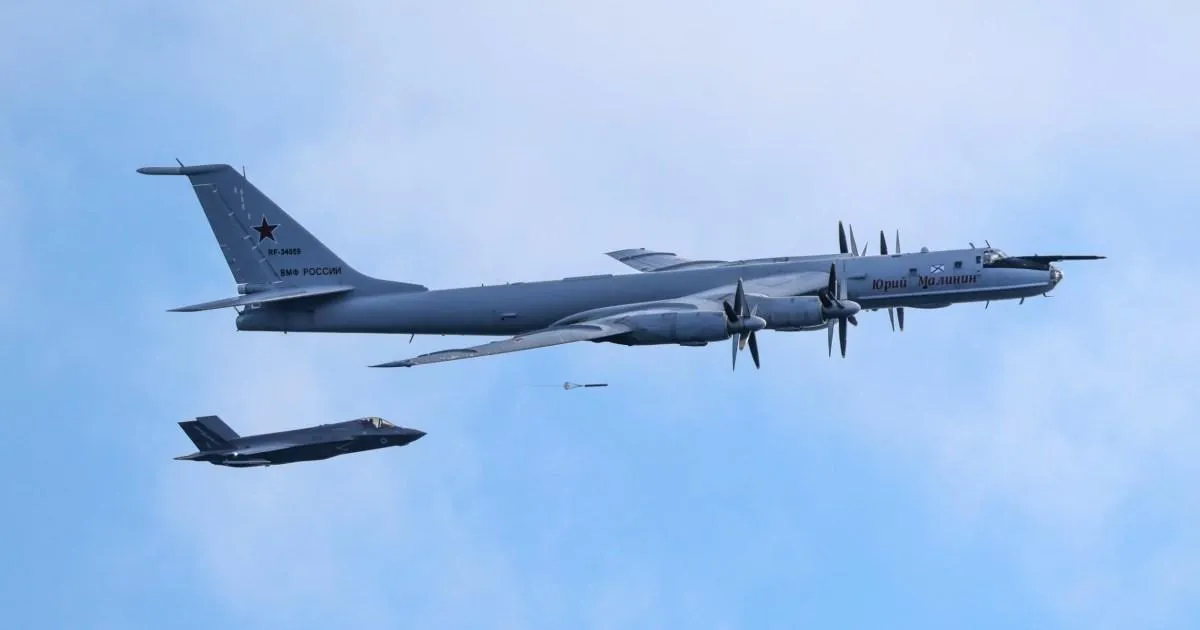
Russia plays war games with UK dropping sonobuoys near aircraft carrier
Russia plays war games with UK dropping – During a recent military exercise in the Norwegian Sea, a British fighter jet was compelled to intercept a Russian aircraft that was deemed to have engaged in ‘unsafe’ maneuvers. The Russian ‘Bear-F’ plane repeatedly approached the carrier strike group, prompting a response from the UK’s naval forces.
Russian Activity Near British Carrier
The Ministry of Defence confirmed that the Russian maritime patrol aircraft deployed a significant number of sonobuoys in the vicinity of the Prince of Wales aircraft carrier. These devices, used for detecting submarines, were released at close range, raising concerns about the safety of the British military assets.
“While conducting operations in the Norwegian Sea as part of Operation Firecrest, the UK’s Carrier Strike Group faced repeated incursions by a Russian ‘Bear-F’ aircraft. The plane flew at low altitude and came dangerously near HMS Prince of Wales, dropping numerous sonobuoys in its vicinity,” stated a Ministry of Defence spokesperson.
The British forces responded by dispatching two F-35 jets from the Prince of Wales to escort the Russian aircraft away from the area. This action was taken to ensure the safety of the carrier group and to demonstrate a readiness to defend against potential threats.
Strategic Positioning and Naval Assets
The carrier strike group is currently based off the coast of Iceland, operating under NATO command. It includes a mix of advanced military equipment, such as the HMS Prince of Wales, the Type 45 destroyer HMS Duncan, F-35 jets, and Merlin and Wildcat helicopters. The RFA Tidespring provides logistical support to the group.
According to defense officials, the Bear-F is believed to have deployed tens of sonobuoys in the surrounding waters. These sonobuoys are essential for underwater surveillance but their proximity to the carrier could be seen as a provocative move, especially in a tense geopolitical environment.
Political Reactions and Defense Funding
Shadow Defence Secretary James Cartlidge criticized Russia’s actions, calling them ‘provocative’ and ‘totally unjustified.’ He emphasized the need for immediate investment in the UK’s defense capabilities, arguing that prioritizing military spending over a larger welfare state is crucial for maintaining national security.
“This incident underscores the real threat posed by Russia across all domains. It’s a clear signal that our armed forces require substantial resources, and Labour must detail how they plan to fund their Defence Investment Program,” Cartlidge added.
Meanwhile, the current Defence Secretary, Dan Jarvis, highlighted the ongoing aggression from Russia during a visit to HMS Prince of Wales. He warned that the threat extends beyond traditional military boundaries, encompassing cyber, space, and naval domains.
“We should be clear-eyed about the fact that the threat from Russia exists in every domain—under the water, on the water, on the land, in the sky, in space, and in cyberspace as well,” Jarvis stated.
As Jarvis prepares for a NATO summit in Turkey, the event follows recent Russian strikes on Kyiv that claimed over a dozen lives. The US has urged NATO allies to boost defense spending immediately, warning of potential consequences if they fail to meet targets. Matt Whitaker, the US ambassador to NATO, noted that some countries like Poland and the Nordic states are leading the way in defense investment, while others lag behind.
“President Trump expects all allies to step up immediately and not only get on a sustainable path to the 5 per cent [of GDP] defense spending target but to achieve it as soon as possible,” Whitaker said.
The situation highlights the complex dynamics within NATO as member states navigate their commitments to collective defense. With the UK’s carrier group stationed in a strategic location, the incident serves as a reminder of the ongoing tensions and the necessity for robust military preparedness. The deployment of sonobuoys near the Prince of Wales underscores the multifaceted nature of modern warfare, where even routine operations can escalate into confrontational scenarios.