
On Iran’s islands, an intriguing portrait carries new meaning
On Iran’s islands, an intriguing portrait carries new meaning
Shifting Tides and Cultural Roots
The islands of Hormuz and Qeshm, situated along the Strait of Hormuz, have long been a crossroads of empires, trade, and migration. Now, amid a war between the US, Israel, and Iran, their tranquil shores are under threat. Iranian mines, US warships, and a blockade have transformed the region into a battleground, disrupting lives once shaped by commerce and cultural exchange.
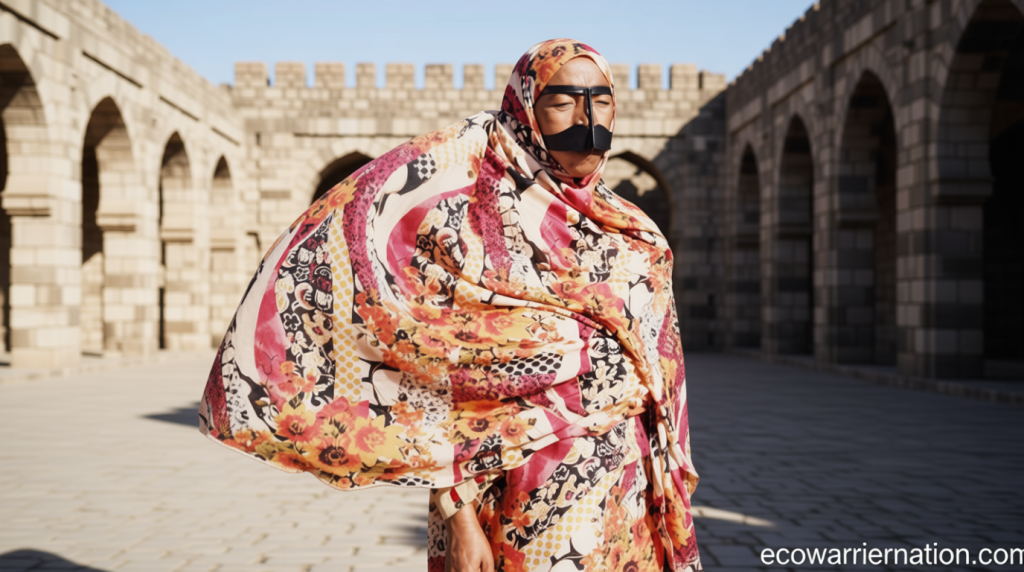
Hoda Afshar, a photographer based in Berlin, has revisited these islands since 2015, capturing their landscapes and the unseen forces that influence daily existence. Her images, often rooted in serendipity, reveal the deep interplay between the physical and metaphysical. One such photograph, taken during a moment of stillness, shows Salimeh standing in her yard, her vibrant red, pink, and orange garments mirroring the mineral-rich sands of the land.
“You see how the connection people have to their landscape determines how they look,” Afshar remarked, highlighting the influence of the environment on clothing and identity.
The image’s intrigue lies in its accidental capture. As Afshar adjusted her medium-format analog camera, the wind lifted Salimeh’s veil, framing her body in a subtle dance with the air. This fleeting gesture, she recalls, was both a trigger and a symbol of the islands’ invisible forces—winds locals view as powerful entities.
Beliefs and the Invisible
Among the islanders, winds are more than natural phenomena. Some are seen as benevolent, while others, like the zār, are believed to infiltrate the body, causing unease or illness. Salimeh’s painted mask, with its thick eyebrows and mustache, embodies this belief, designed to disguise her as male and ward off the spirits.
These traditions, passed through oral memory, reflect a layered history. For centuries, the islands have welcomed merchants, soldiers, and migrants from East Africa, the Arabian Peninsula, and the Indian subcontinent. With them came diverse languages, customs, and stories. Afshar noted that many residents trace their ancestry to Africa, though this heritage is often overlooked or denied.
“The only people believed capable of negotiating with the possessing winds are shamans of African descent,” she said, explaining how historical narratives are reimagined within the zār belief.
Now, as the islands face geopolitical turbulence, Afshar’s work feels more urgent. Her 2021 book, Speak the Wind, explores the tension between visible and invisible, landscape and memory. The photograph of Salimeh, once a quiet study of tradition, takes on new resonance in a world where war reshapes the land and its people.
Even in the absence of conflict, the islands remain deeply connected to their environment. Certain trees are thought to house the winds, and resting beneath them is said to invite possession. Afshar’s series is a testament to how history and culture accumulate, shaping identities and experiences. As new violence alters the present, her images continue to speak of a place where the past and future collide.
