
High-seas boarding of Iran-linked tanker may widen gap US-Iran peace talks will need to bridge
US Seizure of Iran-Linked Tanker Expands Pressure on Tehran in Peace Negotiations
The US military’s interception of an oil tanker in the Indian Ocean on Tuesday underscores its resolve to monitor Iran-connected vessels globally, extending the scope of its maritime restrictions. This move, occurring far from the Persian Gulf, intensifies economic strain on Tehran and may complicate ongoing efforts to reach an agreement with Washington. The operation highlights the US Navy’s capacity to enforce sanctions even in distant waters.
Operation in the Indian Ocean
Gen. Dan Caine, head of the US Joint Chiefs, recently underscored the Navy’s ability to track Iranian vessels across the world. The M/T Tifani, identified by the International Maritime Organization as ship number 9273337, was halted near the INDOPACOM zone, more than 2,000 miles from the Persian Gulf. This location is within the operational area of the US Indo-Pacific Command. Satellite images indicate the tanker had been at Iran’s Kharg Island oil terminal as recently as April 6, before heading toward the Strait of Malacca.
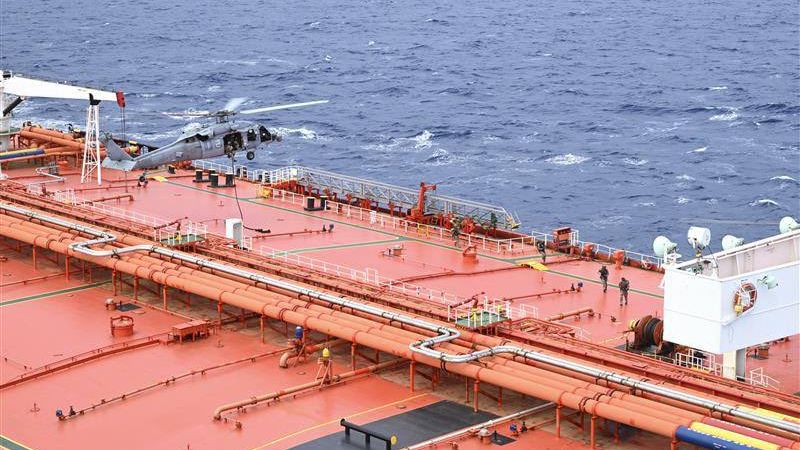
Tracking data revealed the ship’s movements through the Gulf of Oman on April 10, traveling southeast. On April 21, it abruptly changed course, veering south then eastward again after passing Sri Lanka. The US Navy’s boarding operation followed shortly after. Footage from the Defense Department showed troops disembarking from helicopters onto the tanker, which was intercepted by the USS Miguel Keith—a vessel comparable in size to an aircraft carrier.
Resources and Legal Framework
The USS Miguel Keith, part of a fleet of five similar ships, illustrates the scale of the US Navy’s maritime enforcement capabilities. The interdiction also involved a guided-missile destroyer and Marines from an amphibious assault ship, akin to a small aircraft carrier. With 74 destroyers and nine assault ships in its arsenal, the Navy maintains a formidable presence in international waters.
The Touska, an Iranian cargo ship seized earlier in the week, is now under scrutiny. Analysts suggest the ship and its cargo could be classified as war spoils if deemed a “prize” by US authorities. The Justice Department had previously filed a case to seize a Venezuela-linked Iran tanker, seeking to claim its 1.8 million barrels of crude oil. This strategy aligns with the US’s broader campaign against sanctioned vessels.
“As we have made clear, we will pursue global maritime enforcement efforts to disrupt illicit networks and interdict sanctioned vessels providing material support to Iran — anywhere they operate,” the Defense Department stated.
Strategic Implications
Analysts note that open ocean operations offer the US Navy greater flexibility, with fewer neutral ships and no land barriers to hinder maneuvers. This contrasts with the Persian Gulf, where geography and diplomacy can obscure adversaries. Despite these interdictions, Iran has not yet shown signs of nearness to the negotiating table.
The Iranian Foreign Ministry labeled the US actions as a breach of the April 8 ceasefire. It has since declined to dispatch a delegation for upcoming peace talks in Pakistan. The escalation of maritime operations, including the seizure of the Tifani and Touska, signals a possible broadening of the conflict’s reach beyond traditional battlegrounds.
