

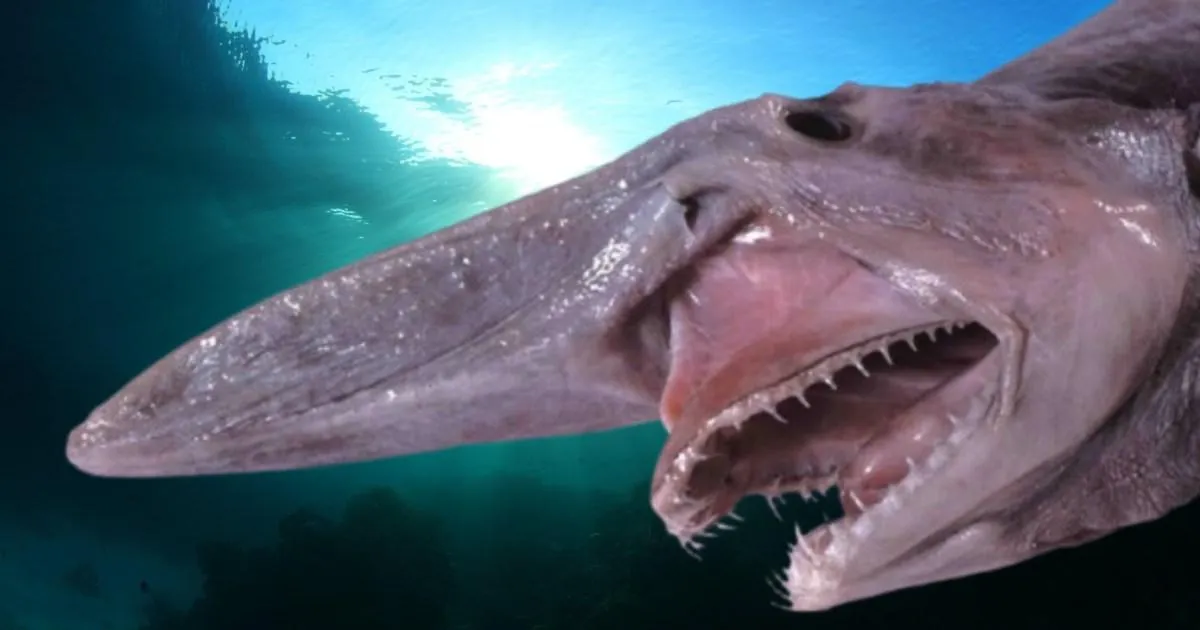
Goblin Shark with ‘Not Even a Mother Would Love’ Face Spotted in Natural Habitat
Goblin with face not even a mother – For the first time, a goblin shark—known for its unsettling, elongated face—has been captured on camera in its natural deep-sea environment. This rare footage, recently shared by researchers, has sparked global interest in the creature, which is often described as one of the most unappealing marine animals. The goblin shark, or *Mitsukurina owstoni*, has long been a mystery to scientists, but its recent live observation has provided critical insights into its behavior and survival strategies in the ocean’s depths.
A Deep-Sea Enigma with a Disturbing Appearance
The goblin shark’s peculiar anatomy, including its comically long snout and skeletal, pale pink skin, has earned it a reputation for being one of the most bizarre species in the marine world. Its face, which many have likened to a grotesque caricature, is so unappealing that it’s often cited as a prime example of nature’s most unforgiving designs. Despite this, the shark’s unique features are believed to be evolutionary adaptations for thriving in the extreme conditions of the abyssal zone.
With its triangular teeth and ghostly appearance, the goblin shark has become a symbol of the ocean’s hidden wonders. Scientists speculate that its elongated face may help it detect prey in the dark, while its deep-sea habitat—where pressure is immense and light is scarce—has made it a challenge to study. The recent footage, however, has offered a rare opportunity to observe these ancient creatures in action, revealing their mysterious behavior for the first time.
Breakthrough in Deep-Sea Observation
Until now, the only evidence of goblin sharks in the wild came from specimens caught by fishing nets in the Atlantic, western Indian, and Pacific Oceans. These sharks were typically found dead or struggling, limiting researchers’ ability to understand their natural behaviors. The breakthrough occurred in the Tonga Trench and near Jarvis Island, where two independent teams documented live encounters, capturing the species’ movements for the first time in its native environment.
The goblin shark’s face, which has been described as ‘not even a mother would love,’ became the focal point of public fascination. Its skeletal structure and gaping mouth, reminiscent of a prehistoric predator, have fueled both scientific curiosity and internet memes. The footage from the *R/V Dagon* expedition, which lasted 50 days, not only confirmed the shark’s presence but also highlighted its importance as a deep-sea survivor.
Evolutionary Significance and Conservation Implications
As a living fossil, the goblin shark has remained largely unchanged for over 125 million years. This evolutionary legacy makes it a key species for understanding how deep-sea life has adapted over time. The recent discoveries have expanded the known range of its habitat, suggesting that these creatures are more widely distributed than previously thought. This finding is crucial for conservation efforts, as it emphasizes the need to protect the deep ocean’s ecosystems.
Experts have praised the breakthrough for advancing marine biology research. “The goblin shark’s face, not even a mother would love, is a testament to nature’s creativity,” remarked Dr. Alan Jamieson, director of the Minderoo-UWA Deep-Sea Research Centre. The team’s ability to observe the species in its natural environment marks a significant step forward in studying deep-sea life, comparable to the rare sightings of the colossal squid.
Public Reaction and Scientific Recognition
Reactions to the goblin shark’s appearance have been as varied as its habitat. While some view it as a marvel of evolution, others have been captivated by its eerie look. The footage has gone viral, with many describing the shark as a “deep-sea monster” or a “living alien.” This public interest underscores the species’ unique place in both scientific and cultural narratives.
Researchers have also noted the importance of such observations in deep-sea exploration. “Even with advanced technology, the goblin shark’s face remains one of the ocean’s most intriguing mysteries,” said Dr. Culum Brown, a marine biologist. The study, published in a leading journal, highlights how the goblin shark’s unappealing appearance belies its ecological significance, offering new perspectives on deep-sea biodiversity.