
Pinwheels and the ‘lobster district’: How Virginia Democrats drew up a US House map to all but lock out Republicans
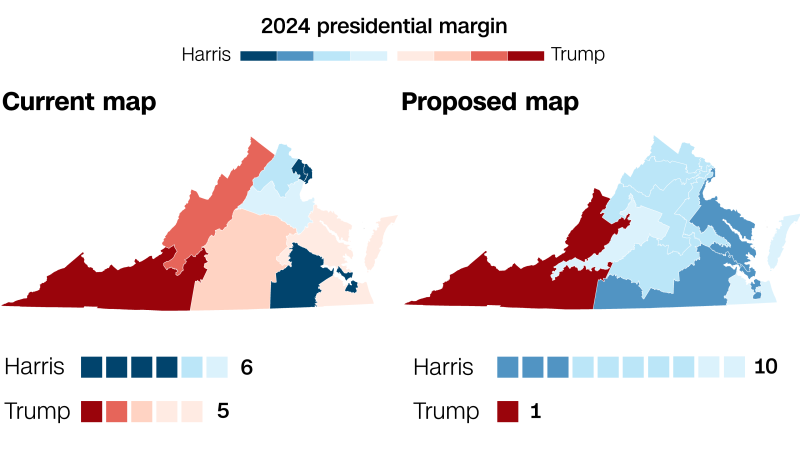
Virginia Democrats’ New Congressional Map Targets Republican Seats
A Shift in Power Dynamics
Virginia Democrats are seeking to secure a significant majority in the US House by proposing a revised congressional map for voter approval on Tuesday. The plan aims to flip four Republican-held districts, potentially giving the party 10 out of 11 seats in a state where former Vice President Kamala Harris narrowly won with 52% of the vote in 2024.
Heavily Democratic northern Virginia would be carved into five separate districts, with districts that pinwheel from outside Washington to hoover up conservative rural areas of the state.
The New Map’s Strategic Design
The proposed map represents a dramatic overhaul of existing boundaries, dismantling previously safe Democratic districts in the DC suburbs and Richmond region. A new district stretches along the Blue Ridge Mountains, linking liberal urban centers while strategically avoiding Democratic strongholds like Charlottesville. This design has drawn comparisons to a lobster due to its elongated tail and two broad claws, creating seats that appear more competitive than those targeted by Texas Republicans.
Comparing Approaches
While Texas Republicans focused on flipping five Democratic seats in their 2024 redistricting efforts, Virginia’s plan introduces districts where Harris secured support by single digits. Under the current map, the Richmond area was largely contained in the 4th District, which supported her by 32 points. The new map splits parts of this region, resulting in a district with a 16-point margin and another with a nine-point advantage.
Republican Opposition and Democratic Rationale
Opponents have highlighted that Governor Abigail Spanberger and former President Barack Obama endorsed nonpartisan redistricting in 2021. However, Democratic leaders argue the updated map is essential to counter President Donald Trump’s strategy. The revised districts in Virginia, including the 6th District that runs alongside the Blue Ridge Parkway, connect Democratic hubs from Harrisonburg to Lynchburg, incorporating both the University of Virginia and Liberty University into a single competitive seat.
Norfolk’s Role in the Redistricting
The Norfolk region, centered around the closely contested 2nd District, sees a subtle but impactful shift. The new map replaces rural Republican areas with Democratic-leaning neighborhoods, adjusting the district’s balance. This change transforms a previously tied race into one where Harris gained a five-point edge, underscoring the Democrats’ aggressive approach to securing electoral dominance.
