
‘Bathtub ring’ offers new evidence for Mars ocean billions of years ago
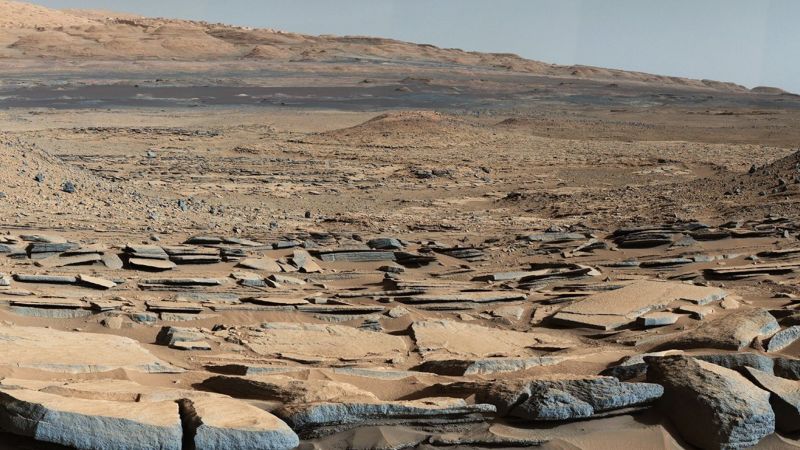
‘Bathtub ring’ offers new evidence for Mars ocean billions of years ago
Recent discoveries hint that Mars might have once been home to a colossal ocean, stretching across one-third of its surface before vanishing eons ago. The remnants of this ancient body of water could be a flat, elevated region of land, mirroring the ring left behind when a bathtub is emptied. If validated by direct observation, this “coastal shelf” identified by researchers would add significant weight to a longstanding scientific discussion about Mars’ watery history.
While features such as dried riverbeds, deltas, and lakebeds indicate Mars had liquid water in the past, experts remain divided on whether it ever supported a large ocean. “The question is: If an ocean existed on Mars and dried up, what would it leave behind?” asked Michael Lamb, lead author of a study published last week in *Nature*. “We sought a band that would trace the former shoreline, like a flat bench — a structure familiar on Earth as the continental shelf.”
“We looked for a similar feature on Mars and found some evidence that it could be there,” Lamb said. “It doesn’t look exactly like Earth’s continental shelf, however, so there’s some support for it, but not all the pieces of the puzzle.”
Lamb, a geology professor at Caltech, and Abdallah Zaki, a postdoctoral researcher at UT Austin, used computer models to simulate Earth’s ocean retreats. The resulting geological patterns revealed that the continental shelf is the most prominent feature, persisting through shifts in sea levels. The team then searched for a Martian equivalent, analyzing data from NASA’s Mars Orbiter Laser Altimeter (MOLA), which maps surface elevations from orbit.
The concept of an ancient Martian ocean dates back to the 1970s, when NASA’s Viking missions uncovered what some interpreted as a shoreline — a narrow band — and a depression in the northern hemisphere thought to mark an old seabed. However, this evidence was never definitive. “The shoreline has some issues,” Lamb noted. “It doesn’t maintain a consistent elevation, instead fluctuating up and down.”
One possible explanation for these variations is volcanic activity, which could have altered the planet’s crust and distorted the shoreline. “But proving that’s what happened remains challenging,” Lamb explained. “Thus, the debate continues over whether these features are truly oceanic.”
Coastal shelf: A stronger indicator
The new study argues that the coastal shelf is a more reliable sign of a large ocean than earlier shoreline theories. This sloping structure, estimated to be 200 to 400 meters wide, is more visible and durable, resisting erosion over billions of years. It forms from river deposits and sea-level changes, much like Earth’s continental shelves.
“On Earth, the continental shelf is the largest sedimentary sink, shaped by rivers and ocean currents,” Zaki added. “We believe the coastal shelf on Mars serves a similar role.”
Zhurong, a Chinese rover that landed in 2021, found traces of ancient beaches in the northern plains, aligning with the researchers’ hypothesis. Geological layers containing river deltas further support this idea. Though Mars now retains water primarily in its ice caps, data from NASA’s InSight lander suggests substantial underground reserves — potentially enough to fill an ocean.
Over time, Mars’ atmosphere thinned, allowing water molecules to escape into space. Some estimates suggest the planet may have had surface water as recently as 2 billion years ago. The “bathtub ring” could soon be confirmed, as the European Space Agency’s rover continues its mission to explore the red planet’s terrain.
