
National Mall prayer event sparks concern about Trump administration eroding the wall between church and state
National Mall Prayer Event Raises Questions Over Trump’s Impact on Church-State Separation
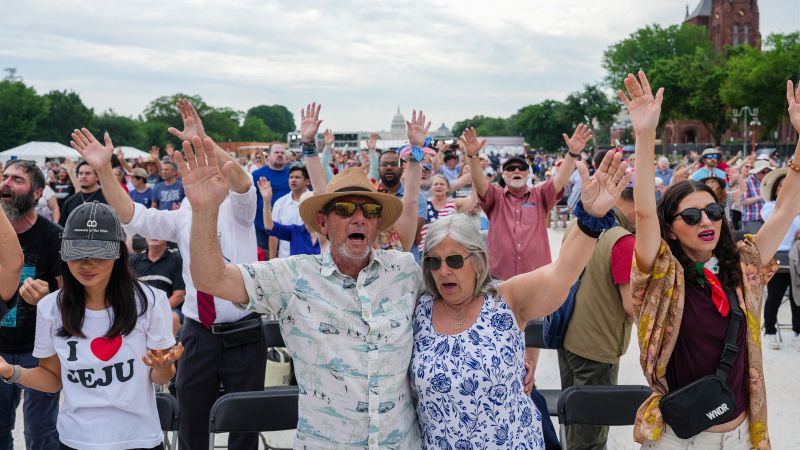
National Mall prayer event sparks concern – On Sunday, a full-day prayer gathering held on the National Mall drew widespread attention, signaling a new chapter in the Trump administration’s efforts to intertwine religious expression with governmental functions. The event, organized under the banner of “Rededicate 250: A National Jubilee of Prayer, Praise & Thanksgiving,” was part of a broader celebration marking the 250th anniversary of American independence. It brought together a mix of religious figures, civic leaders, and performers, all united in a shared focus on faith and national identity. However, the gathering also ignited debate over whether the administration is compromising the principle of separating church and state.
Financed by a combination of public funds and private contributions, the event featured video messages from President Donald Trump and his Cabinet members, emphasizing themes of unity and spiritual renewal. The National Mall, a historic site symbolizing the nation’s democratic ideals, became the backdrop for a ceremony that included a large stage, towering white columns, and stained-glass imagery of the Founding Fathers. Attendees, many in red, white, and blue, were encouraged to reflect on the nation’s heritage and express gratitude for its foundational values. As the event progressed, Trump’s video address included a brief reading from the Bible’s Book of Chronicles, underscoring the administration’s alignment with Christian traditions.
While the White House framed the event as a celebration of America’s spiritual roots, critics argue it represents a deliberate effort to elevate Christianity within government activities. House Speaker Mike Johnson, a prominent Christian figure, delivered a prayer that called for a revival of “piety and patriotism,” further reinforcing the administration’s narrative. Vice President JD Vance later contributed a video statement asserting that “we have always been a nation of prayer,” a sentiment that resonated with attendees who viewed the gathering as a revival of traditional American values.
The organizers of the event, Freedom 250—a nonprofit linked to the National Park Foundation—highlighted its role as a platform for recommitment to national ideals. “Rededicate 250 will be a powerful moment to reflect on where we have been, recommit ourselves to the ideals that define us, and look toward the future with renewed hope and purpose,” said Danielle Alvarez, a senior adviser with the organization. Yet, despite the event’s inclusive invitation, the majority of participants were evangelical Christians, with only a few representing other faiths. This demographic focus has drawn scrutiny from those who believe the administration is favoring a specific religious tradition over the broader spectrum of American beliefs.
Brittany Baldwin, a White House senior policy adviser, described the event as a reflection of the nation’s Judeo-Christian heritage during a planning webinar that was later removed. “Our shared religious legacy is central to understanding who we are as a country,” she stated, a remark that has been cited by opponents as evidence of the administration’s agenda to promote Christianity through public initiatives. One attendee, Vicky Kanaga from Massachusetts, expressed her belief that the gathering offered a chance to “turn our country back to God,” while Ryan Phillips, who traveled from Mississippi with his family, argued that the separation of church and state allows for government and religious influence to coexist.
Legal and Constitutional Debate
Legal scholars have divided on the event’s constitutionality, with some expressing concern over its implications for religious freedom. Andrew Koppelman, a constitutional law professor at Northwestern University, acknowledged that the event was permitted since no court had issued an injunction against it. However, he criticized its alignment with a particular faith, stating, “This kind of divisive embrace of a specific religion and trying to associate the incumbent administration with that religion is bad for religion, bad for government, and bad for America.” Koppelman argued that the First Amendment’s purpose is to ensure religious diversity, not to endorse one tradition over others.
“This kind of divisive embrace of a particular religion and trying to associate the incumbent administration with that religion is bad for religion, bad for government, and bad for America,” said Andrew Koppelman, a professor at Northwestern University’s Pritzker School of Law.
In contrast, Douglas Laycock, a law and religion expert at the University of Texas School of Law, called the event “flagrantly unconstitutional.” He contended that the government’s explicit promotion of Christianity—rather than a general recognition of religion—violated the constitutional principle of religious neutrality. “It is unconstitutional because it is explicit government promotion of religion, and not just religion in general, but of a fairly specific version of one particular religion,” Laycock explained.
Michael Moreland, a professor at Villanova’s Charles Widger School of Law, offered a more nuanced perspective, suggesting that the intersection of faith and the public square is acceptable. “I think that it’s kind of overemphasizing that idea of separation to think that an event like this raises any constitutional problems,” he said, citing the tradition of prayers at congressional sessions and the presidential inauguration as examples of religious expression in government settings. Moreland argued that the First Amendment’s requirements allow for such occasions without undermining the broader principle of separation.
The event’s timing and content have also sparked discussion about the administration’s broader strategies. By integrating faith into national celebrations, the Trump team has reinforced its commitment to Christian values in policy, culture, and governance. Critics contend that this approach risks marginalizing other religions and embedding a specific worldview into public institutions. Meanwhile, supporters view it as a natural extension of American history, where religious influence has long shaped political discourse and national identity.
During a live interview on the National Mall with Fox News, House Speaker Mike Johnson defended the event as a necessary celebration of the nation’s religious and moral foundations. “This gathering is a recognition of the spiritual traditions that have guided our country since its inception,” he said, framing the event as a tribute to historical continuity rather than a modern policy shift. White House spokeswoman Taylor Rogers echoed this sentiment, stating in a statement to CNN that the Rededicate 250 initiative would “foster a renewed sense of purpose and unity among the American people.”
As the debate continues, the National Mall prayer event stands as a microcosm of the ongoing tension between religious expression and constitutional neutrality. Whether it is seen as a symbolic homage to the nation’s roots or a calculated move to entrench Christian influence, the event underscores the enduring role of faith in shaping American politics and public life. The discussion is likely to persist as the administration’s actions in this space continue to redefine the boundaries between church and state.
