
Protests and defeat: Chelsea fans run out of patience with club’s billionaire American owners
Protests and Defeat: Chelsea Fans Lose Patience with Billionaire American Owners
The Overhaul and Its Aftermath
Protests and defeat – Four years into the reign of Todd Boehly’s BlueCo consortium, Chelsea fans are grappling with a sense of disillusionment. When Boehly, a US billionaire businessman, took control of the club in May 2022, he vowed to transform it into a dominant force in English football. “We’re all in – 100%,” he declared to supporters, emphasizing the consortium’s commitment to securing top-tier talent and ensuring the club’s future. Yet, as the season draws to a close, the vision has unraveled, leaving fans to question the value of the investment. The team’s struggles this campaign have culminated in a disappointing FA Cup final loss to Manchester City, sparking widespread discontent and a rare public demonstration of frustration.
Disappointment on the Pitch
Chelsea’s current position in the league—ninth place—reflects a significant decline from its former glory. The club’s inability to qualify for the Champions League, a goal long considered essential for its stature, has become a symbol of the owners’ missteps. Despite the financial firepower at their disposal, the squad’s quality has not translated into consistent results. A recent string of seven consecutive league losses has left even the most loyal supporters feeling uneasy. On the day of the FA Cup final, a fan on the tube expressed doubt about the team’s chances, joking, “I think we’re going to get smashed.” His companion replied, “I think you’re probably right,” highlighting the shared sense of pessimism.
A Fractured Fanbase
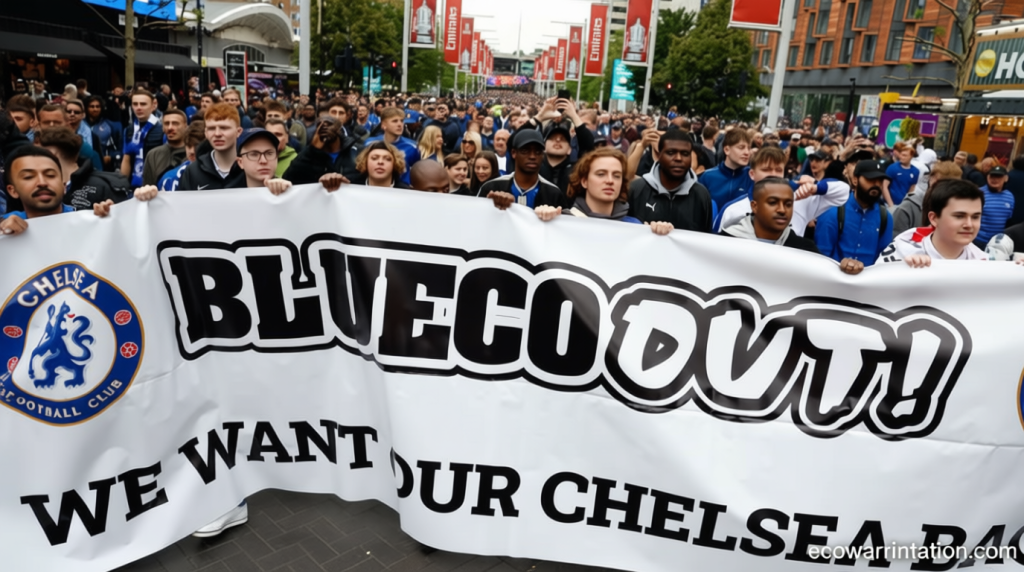
The emotional toll of the season’s failures has fractured the fanbase. At Wembley, as the final whistle blew, the usually passionate supporters were left disheartened. While the team gave a respectful applause to the crowd, many fans turned their backs and hurried toward the exits, their enthusiasm sapped by years of underperformance. This moment captured the growing divide between the club and its supporters, who once celebrated victories with unwavering unity. The protest that preceded the FA Cup final underscored this rift, with fans marching along Wembley Way holding a banner that read: “BlueCo out! We want our Chelsea back.” The sign was a stark reminder of the expectations that have not been met.
Financial Commitments and Squad Expansion
Boehly’s ownership has seen Chelsea spend over $1 billion on player transfers since the takeover. While this influx of funds was intended to build a competitive edge, it has instead led to a bloated squad. The team now features an array of young talents signed to lengthy contracts, a strategy that has not yielded the promised returns. Instead, the squad lacks cohesion and depth, with players struggling to adapt to the high-pressure environment. The result is a team that, despite its financial backing, appears unprepared to contend with elite opposition. In the FA Cup final, Chelsea’s inability to challenge Manchester City effectively highlighted this gap in quality.
Managerial Instability and Leadership Concerns
The managerial turmoil further compounds the club’s issues. Calum McFarlane, who led the team in the FA Cup final, is acting as an interim coach, a role that has become synonymous with uncertainty. The decision to appoint him temporarily reflects the owners’ hesitation in committing to long-term leadership. Behind McFarlane lies a history of managerial upheaval, with former coaches like Liam Rosenior and Enzo Maresca also facing short tenure. Rosenior, recently dismissed after being lured from Strasbourg, is the latest casualty. Maresca, who once guided Chelsea to the FIFA Club World Cup, stepped down in January, citing frustration with the current system. These departures signal a lack of stability and a pattern of poor decision-making.
Financial Power vs. Tactical Vision
While Boehly’s wealth has allowed Chelsea to assemble a star-studded roster, it has also enabled a recruitment approach that prioritizes quantity over quality. The strategy of signing young players to extended contracts in hopes of future profit has backfired, creating a squad that is both large and inexperienced. This approach has left the team without the leadership and tactical nous required to thrive in top-tier competition. Fans, accustomed to the club’s success, now demand more than just financial investment—they want a clear vision and results. The recent loss to Manchester City has become the final straw, forcing supporters to confront the reality of Boehly’s tenure.
A New Chapter or a Decline?
With the FA Cup final defeat, the pressure is mounting on the owners to act. Reports indicate that Xabi Alonso, the former Real Madrid and Bayer Leverkusen manager, may soon be appointed as the new head coach, tasked with rebuilding the team’s identity. Yet, even with a fresh start, the challenge remains daunting. The squad’s size and the lack of experience suggest that a change in leadership alone may not be enough to reverse the tide. Fans are now calling for a complete overhaul, from the boardroom to the training ground, to restore the club’s former standards.
The Cost of Ambition
Boehly’s ambitions for Chelsea have come at a steep price. The club’s hierarchy has spent lavishly, but the returns have been disappointing. The failure to secure consistent wins, coupled with the exodus of managers, raises questions about the effectiveness of the ownership model. Fans, once steadfast in their support, now find themselves at odds with the direction the club is taking. The FA Cup final was not just a sporting loss—it was a symbolic moment that exposed the deepening disconnect between the owners and the supporters. As the season concludes, the focus shifts to what lies ahead: will Boehly’s vision evolve, or has it already been overshadowed by the club’s struggles?
The discontent among Chelsea fans is not merely about the final result but about the cumulative effect of four years of ownership. From a bloated squad to a lack of direction, the club’s trajectory has shifted away from the high standards once associated with its name. While the financial resources are there, the execution of the plan has faltered, leaving supporters to wonder if the new owners have truly embraced the culture of Chelsea or if they are simply reshaping it in their own image. The FA Cup final served as a microcosm of these frustrations, with fans forced to confront the reality that their beloved club may no longer be the powerhouse it once was.
Looking Ahead: A Test of Resolve
As Chelsea prepares for the next phase, the stakes have never been higher. The owners must address the issues that have plagued the team: poor recruitment, managerial instability, and a lack of cohesion. Whether the club can reclaim its former status or continues its downward spiral will depend on how quickly these problems are resolved. For now, the final loss to Manchester City stands as a reminder that, despite the resources and promises, the true measure of success lies on the pitch—and it has not been met.
