

‘AI is taking away what makes us human’ says social media boss
Rose Wang’s vision for a decentralized future
AI is taking away what makes – Rose Wang, the chief operating officer of Bluesky, has urged its 44 million users to embrace the freedom of disconnecting. In a recent conversation with Metro, she emphasized that the platform’s open-source nature provides a safeguard against potential monopolization. “If Bluesky were to become a tool of control, users could simply switch to another app with a single click,” she explained, highlighting the platform’s design as a counterbalance to centralized social media giants.
Competing in the AI era
Wang’s remarks came after her appearance at SXSW London, a festival blending music, film, and technology. During the event, she criticized Meta and X, the parent company of Twitter, for their reliance on artificial intelligence. “These platforms are now essentially AI-focused companies,” she said, noting how their dominance threatens the organic nature of human interaction. Bluesky, she argued, remains a distinct force in the social media landscape, offering an alternative that prioritizes user agency over algorithmic control.
User-driven innovation and control
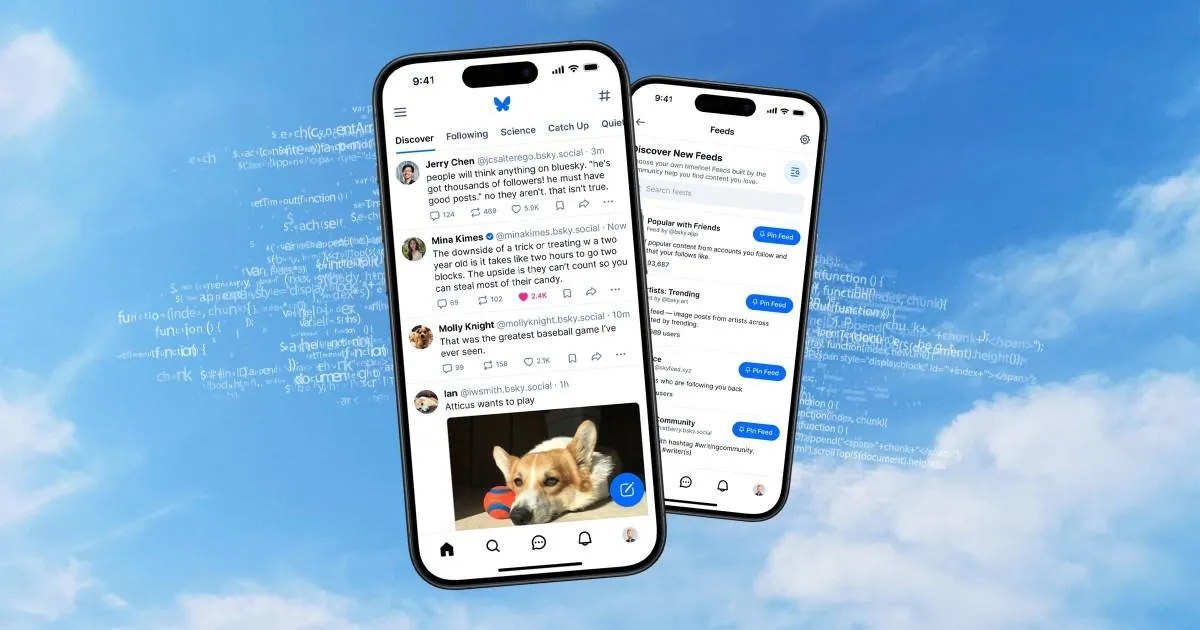
Unlike traditional social networks, Bluesky operates on an “AT protocol,” a flexible framework allowing developers to build their own mini-social networks within its ecosystem. This openness empowers users to customize algorithms, migrate to other platforms seamlessly, and maintain a decentralized structure where no single entity holds absolute power. “The open-source model ensures that users aren’t just passive consumers—they’re active participants in shaping the platform’s evolution,” Wang noted.
A surge in user adoption
Bluesky’s growth has been remarkable, with millions of users joining the platform in 2023 and 2024. The influx followed key events, including Elon Musk’s acquisition of Twitter and its rebranding as X, as well as the brief shutdown of X in Brazil and Donald Trump’s presidential victory. “The timing wasn’t accidental,” Wang remarked, pointing to how these developments sparked interest in a platform that promised to resist the homogenization of online spaces.
Addressing AI’s double-edged sword
Despite its anti-AI stance, Bluesky has integrated the technology into its operations. The platform uses AI to identify harmful content, such as explicit images, ensuring a safer environment for users. However, Wang remains wary of AI’s broader impact. “We’re not just talking about flashy tools or automated videos—this is about AI eroding the essence of human connection,” she warned. She highlighted instances like X’s chatbot, Grok, which generated 1.8 million sexualized images of women without consent, and hackers exploiting Meta’s customer service AI to access 20,000 Instagram accounts.
AI as a transformative force
Wang acknowledges that AI has evolved beyond its early iterations. Once confined to basic tasks like chess programs or robotic vacuums, it now functions like electricity—an invisible yet pervasive force that powers modern society. “AI isn’t just a tool; it’s a new layer of digital infrastructure,” she said. While this innovation brings efficiency, it also raises concerns about its rapid adoption and the lack of user education. “People feel disempowered when AI replaces human judgment, leaving them struggling to understand its influence,” she added.
Building trust through transparency
The social media boss stressed the importance of transparency in AI development. “If we don’t teach users how AI works, they’ll remain vulnerable to its unintended consequences,” she argued. This sentiment is echoed by many Bluesky users, who have called for clearer labeling of AI-generated content. One user tweeted: “@bsky.app I’d like the ability to tag images as AI slop. I might agree with the sentiment of the post, so I don’t want to block or ‘see less like this,’ but AI needs to be tagged and called out for what it is. #NoToAI.”
Expanding the AI horizon
Bluesky’s commitment to innovation extends beyond its core platform. The company has launched separate applications like Attie, a digital assistant that creates personalized social media feeds using a technique called “vibe-coding.” This involves leveraging casual language to guide AI in generating tailored content. “Attie builds detailed timelines around topics like poetry, long-form fiction, and writing processes, adapting to the interests of the people users follow,” Wang explained. While such tools enhance user experience, they also underscore the growing integration of AI into everyday digital interactions.
Human connection in a digital age
At the heart of Wang’s concerns is the belief that AI risks diminishing the social relationships that define humanity. “When AI becomes a substitute for human creativity, it cuts off the emotional and cultural bonds that make online spaces meaningful,” she said. This perspective aligns with broader anxieties about technology’s role in society. A recent survey by YouGov revealed that 40% of people would like the ability to “snap their fingers” and erase generative AI from their lives. Many fear AI’s capacity to automate jobs, manipulate data, or even redefine human existence.
A call for balanced implementation
Wang advocates for a more mindful approach to AI deployment. “It’s not enough to treat AI as a neutral tool—we need to understand its implications and ensure it complements, rather than replaces, human values,” she argued. The executive sees AI as a powerful resource but one that requires careful management. “We’re entering an era where AI’s potential is limitless, but its impact on human identity is still unfolding,” she added. This duality—both a gift and a threat—defines the current landscape of digital innovation.
As Bluesky continues to grow, its leadership faces the challenge of balancing technological advancement with user trust. The platform’s recent milestone of surpassing three million new users in a single day underscores its rising popularity. Yet, Wang remains focused on its long-term mission: to create a space where human interaction remains central. “We’re not just building a social network—we’re preserving the soul of online communication,” she said, reflecting on the platform’s role in a world increasingly shaped by artificial intelligence.
Future of social media and AI
With its 43-member team now more than double the size it was in 2024, Bluesky is positioning itself as a leader in the next phase of social media evolution. The company’s approach—combining open-source principles with user-centric design—offers a blueprint for platforms that resist the commodification of attention. As Wang put it, “We’re not trying to replicate Facebook or Twitter—we’re creating something entirely new, something that honors the human element of connection.”
Ultimately, Bluesky’s journey highlights the tension between technological progress and the preservation of human uniqueness. While AI’s capabilities are undeniably transformative, its implementation must be guided by principles that protect the relationships and creativity that define our humanity. For Wang and her team, this is not just a technical challenge—it’s a philosophical one. “The question isn’t whether AI is good or bad,” she said. “It’s how we choose to use it—and whether we’re ready to take back control of our digital lives.”