
Builders challenge stereotypes and each other to end violence against women
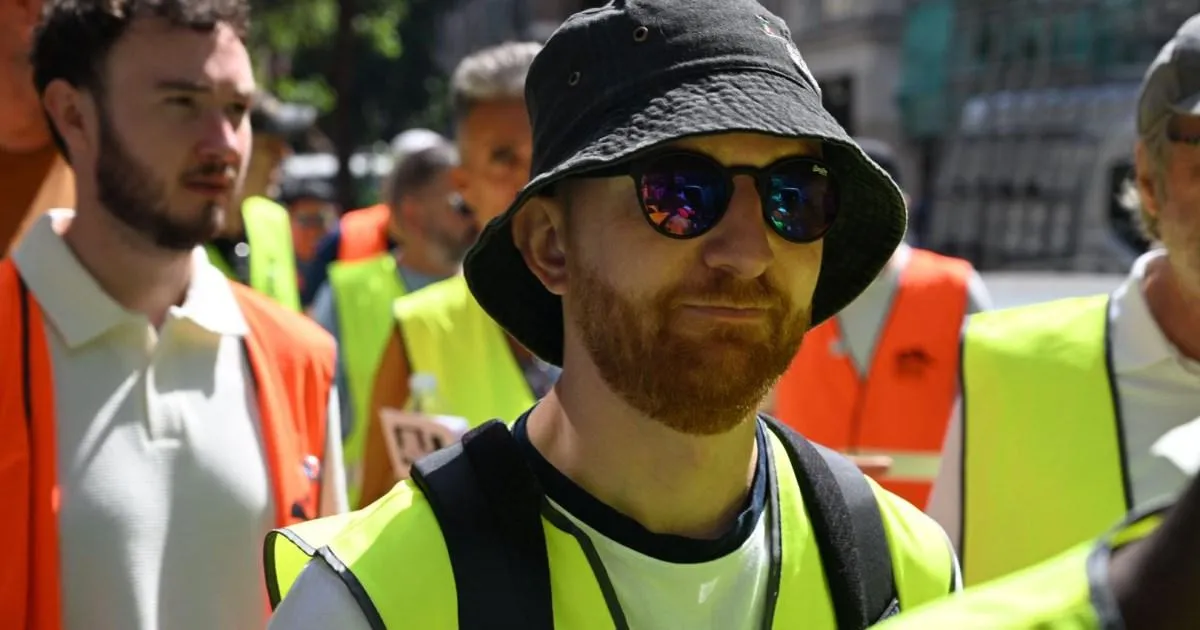
Builders challenge stereotypes and each other – On a sweltering Thursday in central London, a group of construction workers in bright high-visibility jackets gathered to participate in a symbolic march. Their attire, typically associated with labor in the heat of a construction site, was now part of a broader effort to spotlight a pressing social issue. The demonstration, organized by Killed Women, aimed to unite men in hard hats with families affected by violence against women and girls, sending a message that change is possible.
The 10-kilometer route took participants past construction zones and toward Downing Street, where they hoped to engage in conversations about gender-based violence. This walk was more than a physical journey—it was a call to action for men to confront their own behaviors and challenge the stereotypes that perpetuate abuse. By taking part, the builders sought to demonstrate that masculinity can be redefined to prioritize respect and safety over dominance and control.
“We have an opportunity to show young men, who might be a lost generation, an alternative pathway to have a successful career that they can be in control of,” said Michael Alan Hook, a 61-year-old co-owner of LMG, a digital construction services provider. “They don’t have to turn to people like Andrew Tate to define their identity.” Hook’s words echoed the collective resolve of the marchers, who believed that the construction industry could become a catalyst for cultural change.
Malachi Lynch, a 19-year-old builder from east London, shared his perspective on the event. He emphasized the hidden prevalence of domestic abuse, noting that many men hesitate to speak out due to fear of being labeled as “uncool” or “cringey.” “Some men don’t recognize the severity of their actions until it’s too late,” Lynch said. “But if we can open their minds, we might change the way they see relationships and power dynamics.”
The march was part of This Is Not Right, a campaign launched by Metro on November 25, 2024, in partnership with Women’s Aid. The initiative focuses on raising awareness about the national emergency of violence against women, highlighting its scale and impact. Through this collaboration, Metro aims to foster dialogue and encourage men in male-dominated fields to take responsibility for ending the cycle of abuse.
A tragic case that fuels the cause
Leon Westcarr, a 64-year-old resident of Leeds, brought a deeply personal dimension to the campaign. His niece, Kennedi Westcarr-Sabaroche, was found dead in a car in Hackney in April 2024 after being strangled by her partner. “Men are the perpetrators of these violent and heinous crimes,” Westcarr said. “Women are being killed by men, and men have got to be part of that solution. They must challenge each other’s behaviors and attitudes to prevent such tragedies.”
“I’m totally devastated by the outcome of the case,” Westcarr added. “It’s shocking that after less than two years of the crime and less than five months of the sentence, clinicians can grant him escorted leave to be out in the community. This shows how easily the system can overlook the gravity of these acts.”
Kennedi’s family continues to push for a reassessment of the sentence given to her killer, Gogoa Lois Tape, who was initially charged with murder but later accepted a guilty plea to manslaughter due to diminished responsibility. The incident underscores the urgent need for men to take accountability, not just in their personal lives but also in their workplaces.
Stories that resonate beyond the march
For Daniel Wing, whose mother, Tina Wing, was killed in 1992 while on an unaccompanied walk at Friern Barnet Hospital, the event held profound significance. Tina’s death, which remains unsolved, occurred when she was visiting the mental health facility in northwest London. Her body was discovered four hours later with multiple stab wounds and signs of strangulation. “She is not the only woman it happens to,” Wing said, reflecting on the lasting impact of domestic violence on families.
“There are some really horrific stories,” Wing explained. “My mother’s death has shaped my understanding of how violence can affect even the most vulnerable individuals. Seeing men in the construction industry take part in this march gives me hope that we can break the pattern of silence and complicity.”
The campaign’s focus on Hard Hats & Open Minds highlights the role of male-dominated industries in addressing both workplace and domestic abuse. Organizers argue that by fostering open-mindedness among workers, these sectors can become frontline allies in the fight against gender-based violence. The march serves as a reminder that progress requires collective effort and a willingness to confront ingrained attitudes.
As the event concluded, participants and families alike remained committed to the cause. The walk was a symbol of solidarity, bridging generations of builders and victims of violence. It also sparked discussions about how to sustain momentum beyond the day, ensuring that the message of accountability and change continues to resonate in communities across the UK.
Related Stories
More news from Metro: – Sadiq Khan asks, “Why is Trump so obsessed with me?” after the President’s latest rant – Sadiq Khan rolls out a heat plan for London inspired by a scorching desert city – Morrisons faces backlash for placing a monkey toy in the world foods aisle, sparking accusations of a “racist joke”
This site is protected by reCAPTCHA, and the Google Privacy Policy and Terms of Service apply. Your information will be used in line with our Privacy Policy.