

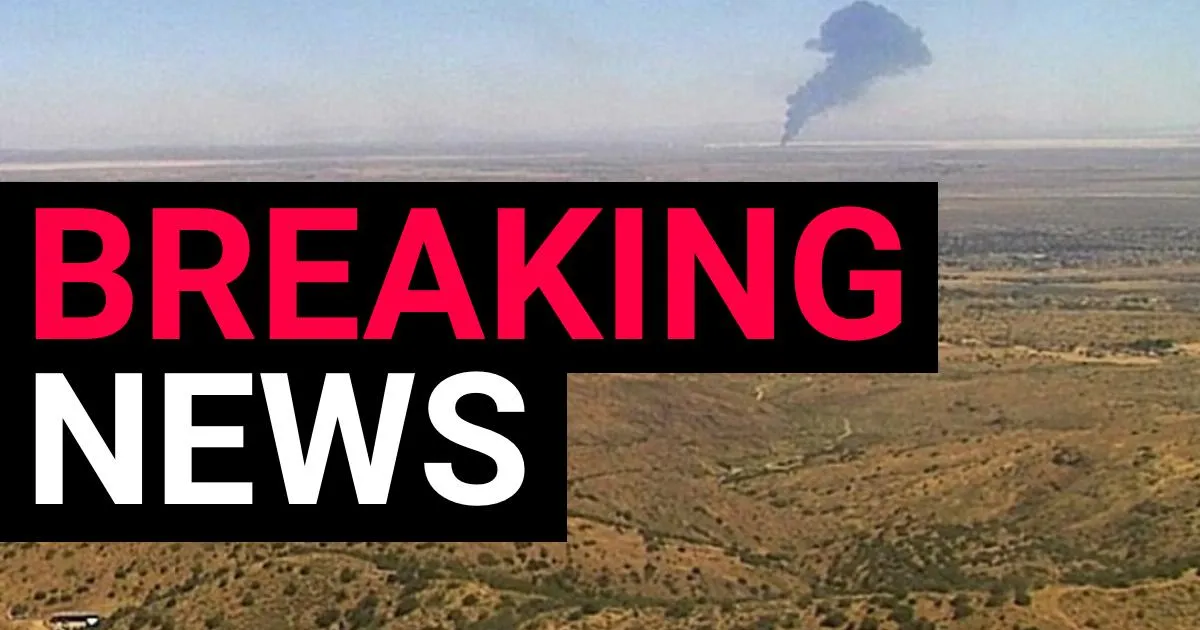
B-52 bomber crashes in California desert ‘shortly after takeoff’
B 52 bomber crashes in California – On June 15, 2026, a United States Air Force B-52 Stratofortress came down in flames during its initial ascent from Edwards Air Force Base, located in the heart of California’s Mojave Desert, just northeast of Los Angeles. The incident, which occurred at approximately 11:20 a.m., sent a towering black plume of smoke into the sky, marking the beginning of an emergency response that quickly mobilized nearby crews.
“The crash took place shortly after takeoff, and emergency teams are now on site to assess the situation,” stated the base via Facebook. “Further updates will be provided as the investigation progresses.”
Edwards Air Force Base, a key testing ground for military aircraft since the 1940s, is now dealing with the aftermath of the crash. The runway, a critical component of the base’s infrastructure, bears a large blackened scar from the impact. While the wreckage remains scattered and not immediately visible in local news footage, the focus has shifted to containing the emergency and ensuring the safety of the surrounding area.
The crash has prompted immediate action from the base’s operations team. As of now, the airfield is closed to all incoming and outgoing flights, with inbound aircraft being redirected to alternate locations. Additionally, all non-commercial visitor passes have been suspended until further notice, as the base prioritizes its emergency response efforts. The decision to close the facility highlights the seriousness of the incident and the need for thorough investigation.
Historical significance of the B-52 Stratofortress
The B-52 Stratofortress, a heavy bomber that has been a cornerstone of the U.S. Air Force for decades, is one of the oldest aircraft still in active service. First introduced in the 1950s, it became synonymous with the Cold War era, serving as a strategic asset during numerous military operations and deterrence missions. Despite its age, the aircraft remains a vital component of the Air Force’s fleet, known for its durability and versatility in modern warfare.
Today, the B-52’s design is still relevant, as it is equipped to carry a crew of five and can transport up to 70,000 pounds of bombs, missiles, or other ordnance. The B-52H variant, which is the latest model in production, is particularly notable for its nuclear capabilities, making it a key player in both conventional and strategic bombing missions. Recent reports indicate that the aircraft has been deployed over Iran, where it has taken part in targeted strikes as part of ongoing military operations.
Operational impact and public reaction
The crash has not only affected the immediate operations at Edwards Air Force Base but also raised questions about the safety of older aircraft models. While the B-52 is renowned for its reliability, incidents like this underscore the challenges of maintaining such legacy systems in contemporary combat scenarios. Emergency crews are working tirelessly to secure the site and begin the recovery process, which may take several hours or even days.
Local media has captured the aftermath, with footage showing the extent of the damage left on the runway. However, the initial view of the wreckage is obscured by the dark plume that has spread across the area, leaving many to speculate about the nature of the crash. The base’s spokesperson has confirmed that the situation is still unfolding, and no official cause has been determined at this time.
As the incident unfolds, the broader implications for the Air Force’s operations remain under scrutiny. The closure of Edwards Air Force Base has disrupted scheduled flights and delayed missions, creating a ripple effect across the region’s aviation network. This disruption highlights the interconnected nature of military logistics and the importance of key facilities like Edwards in maintaining operational readiness.
Looking back, the B-52 has been a symbol of American airpower, participating in conflicts from Korea to Vietnam and beyond. Its ability to adapt to evolving threats has allowed it to remain in service for over six decades, a testament to its enduring design. Yet, the crash serves as a reminder that even the most advanced technology is not immune to mechanical failures or unforeseen circumstances.
Context of recent military actions
Recent military actions in the region have placed the B-52 in the spotlight, with its use in bombing missions over Iran drawing attention from both domestic and international observers. These operations, which have been part of a larger strategic campaign, have sparked debates about the role of airpower in modern conflicts and the potential for collateral damage. The crash adds a new dimension to these discussions, raising concerns about the risks associated with deploying such aircraft in high-stakes environments.
Notably, the incident occurred just days after President Trump expressed regret over the bombing of Iran, stating that he had “felt badly” about the strike. However, Tehran claimed victory, asserting that the attack had undermined its efforts to secure a peace deal with the United States. This context underscores the geopolitical tensions that continue to shape military decisions and the high stakes involved in such operations.
Despite the ongoing investigation, the crash has already had a significant impact on the Air Force’s operations. The suspension of visitor passes and the redirection of flights demonstrate the base’s commitment to safety and efficiency. As the situation evolves, the focus will likely shift to understanding the causes of the crash and implementing measures to prevent future incidents.
For now, the Mojave Desert remains the stage for this unexpected event, with emergency crews working to manage the aftermath and the public eye keenly watching the developments. The B-52’s presence in this area, a testament to its long history of service, now carries the weight of a recent setback that could influence its future operations. The base’s statement on Facebook serves as a reminder of the unpredictability of military aviation and the importance of rapid response in critical moments.