
Britain’s hard right on the march as tens of thousands descend on London
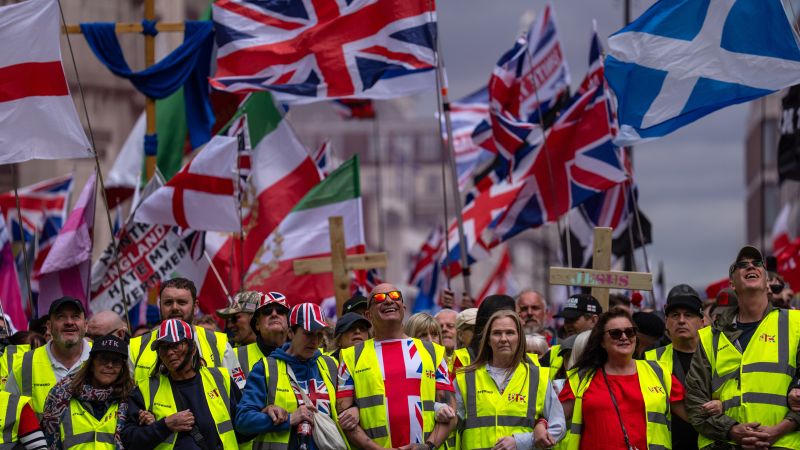
Britain’s hard right on the march as tens of thousands descend on London
Britain s hard right on the march – In a striking display of political shift, a fresh wave of supporters for Britain’s hard-right factions converged in the capital this weekend, gathering under the banner of the “Unite the Kingdom” rally. While the event drew fewer participants than the September demonstration, it marked another chapter in the growing influence of far-right voices across the nation. With calls for a return to nationalistic values and a rejection of perceived foreign influences, the march underscored a broader trend of public sentiment aligning with movements that challenge mainstream political narratives.
A gathering of diverse ideologies
The “Unite the Kingdom” rally, organized by Tommy Robinson—the controversial figure known for his anti-Muslim rhetoric and past legal troubles—brought together individuals from various political backgrounds. Unlike the September rally, which featured a high-profile international guest, this event was more locally focused. Yet, the message remained consistent: a demand for a Britain defined by tradition, security, and national identity. Among the attendees was Pete, a 64-year-old resident of Derbyshire, who spoke passionately about the need to address immigration. “Millions have got to go,” he declared. “They shouldn’t be in this country. They’re claiming benefits. ‘Benefit Britain’ has got to end.”
From militancy to mobilization
Robinson, whose real name is Stephen Yaxley-Lennon, has long been a vocal advocate for stricter immigration controls and cultural preservation. His latest rally echoed the militant tone of the September gathering, where the atmosphere was charged with urgency. During that event, Elon Musk, the American entrepreneur, had warned the crowd that “whether you choose violence or not, violence is coming to you. You either fight back or die.” This time, the focus shifted to activism. “Are you ready for the Battle of Britain?” Robinson asked his supporters, gathered in Parliament Square. “We must get involved and become activists, or we are going to lose our country forever.”
Labour’s instability and the far-right’s rise
The political landscape in Britain has been reshaped by recent upheavals within the Labour Party. Prime Minister Keir Starmer, who has struggled to quell dissent among his own lawmakers, faces mounting pressure as the party’s unity wavers. This instability has emboldened hard-right groups, providing them with an opportunity to gain traction. Despite Starmer’s acknowledgment of peaceful protests, he criticized the organizers of the “Unite the Kingdom” rally for promoting “hatred and division.” His government, he argued, had taken steps to block visas for far-right agitators aiming to spread extremist ideologies.
Yet, Starmer’s vision of a fair and respectful Britain appears to be fading. The rally’s participants, many of whom wore the turquoise color associated with Reform UK, a party led by Nigel Farage, demonstrated a preference for a more combative stance. Farage, a key architect of Brexit and a longtime ally of former U.S. President Donald Trump, has rebranded his party with a more measured approach. Analysts credit his focus on pragmatic policies and tempered rhetoric for the party’s recent electoral gains. However, this strategy has not satisfied all hard-right advocates, who feel Reform UK’s message is insufficiently radical.
Conflicting priorities and a fractured movement
For some, the movement’s direction is shifting further right. At the rally, the “Restore Britain” flag became a prominent symbol, representing the growing support for the party led by Rupert Lowe. Lowe, who was expelled from Reform UK last year over allegations of workplace bullying, claims his ousting was due to a threat to Farage’s leadership. While his supporters argue that his leadership offers a more uncompromising path, others see him as a necessary evolution in the far-right’s strategy. Lowe’s party advocates mass deportations and envisions a “hostile environment” for immigrants, emphasizing the need to protect national sovereignty.
With the next general election not scheduled until 2029, the urgency of the movement has intensified. Many in Britain are questioning whether Starmer’s government will endure that long, given the increasing influence of hard-right factions. The rally’s timing—amid a turbulent week in Westminster—has further fueled these concerns. As Starmer grapples with internal challenges, the hard-right movement continues to consolidate its presence, leveraging public frustration with immigration and cultural change.
Policed tensions and symbolic clashes
London’s Metropolitan Police deployed a significant operation to monitor the event, anticipating potential conflicts. Fears of a clash between the “Unite the Kingdom” march and a pro-Palestinian demonstration elsewhere in the city prompted heightened security measures. While the Met reported 11 arrests for various offenses, no violent incidents were observed. Nevertheless, the rhetoric was sharp. One speaker praised the crowd for “defending our own (Christian) faith in our own land,” asserting that Britain’s soil was “soaked and saturated with the blood of Christian men and women.” This reference to historical struggles, such as the fight against Nazis during World War II, underscored the march’s nostalgic appeal.
Although the event’s primary goal remains unclear, its participants insist on restoring a perceived era of national greatness. For them, the rally is not just about policy but about reclaiming a sense of identity and purpose. The inclusion of pro-Palestinian demonstrators in the city highlights the complex dynamics at play, as the hard-right movement’s focus on immigration intersects with broader global issues. Despite these tensions, the march’s success has reignited debates about the future of Britain’s political direction.
From slogan to strategy
As the hard-right movement gains momentum, its strategies are evolving. While Robinson’s rallies remain a cornerstone of public engagement, the movement is increasingly drawing from a coalition of groups that share overlapping goals. This includes Reform UK’s shift toward pragmatism and the more confrontational stance of Restore Britain. The growing numbers of attendees suggest that these efforts are resonating with a significant portion of the population, particularly those who feel marginalized by multiculturalism and globalism.
The rallying cry of “Unite the Kingdom” has become a powerful slogan, symbolizing a desire for unity and a return to traditional values. This sentiment is amplified by figures like Musk, whose endorsement of Rupert Lowe has further legitimized the movement’s ambitions. For Pete and others like him, the march represents a call to action against what they see as a threat to British identity. As the political climate continues to shift, the hard-right’s presence in the public square signals a lasting transformation in the nation’s discourse.
The question now is whether this movement will sustain its growth or fade into obscurity. With the next election still years away, the hard-right’s influence may continue to shape British politics, challenging both mainstream parties and altering the nation’s trajectory. As the marchers left Parliament Square, their message was clear: the fight for a “great Britain” is far from over.
