
Brave Officer Prevents Catastrophic Petrol Station Blaze by Tackling Man with Lighter
Hero officer tackles man with lighter – Heart-stopping video captures the dramatic instant when a police sergeant risked his own safety to prevent a devastating explosion at a busy forecourt. The footage reveals Sgt Charlie Thompson lunging at an agitated individual who was moments away from igniting himself while covered in fuel.
The Critical Moment at the Forecourt
During October of last year, Thompson found himself at the center of a tense confrontation at a Tesco petrol station in Stratford-upon-Avon. The unnamed man had already saturated his clothing with petrol and was standing merely inches from the fuel pumps when officers arrived on the scene.
What made the situation particularly dangerous was the man’s position relative to the pumps. Had he struck the lighter at that moment, the resulting blast could have caused catastrophic damage to the entire station and potentially killed bystanders and staff alike.
Video evidence from the incident shows the man pacing and demanding to speak with various officials, including local leadership such as the mayor. His agitation was evident as he threatened to set himself alight and gave emergency responders a strict fifteen-minute deadline to address his concerns.
Thompson’s Quick Thinking Saves Lives
Throughout the standoff, Sgt Thompson maintained a calm demeanor while communicating with the distressed individual. His words, captured on audio, reveal his strategic approach to de-escalating the situation.
I will try and do what I can. I won’t talk to you while you are holding a lighter. I will talk to you, but not here. We need to get you away from here. Tell me what’s going on. You don’t need to be doing this. What is this about? You need to be very careful.
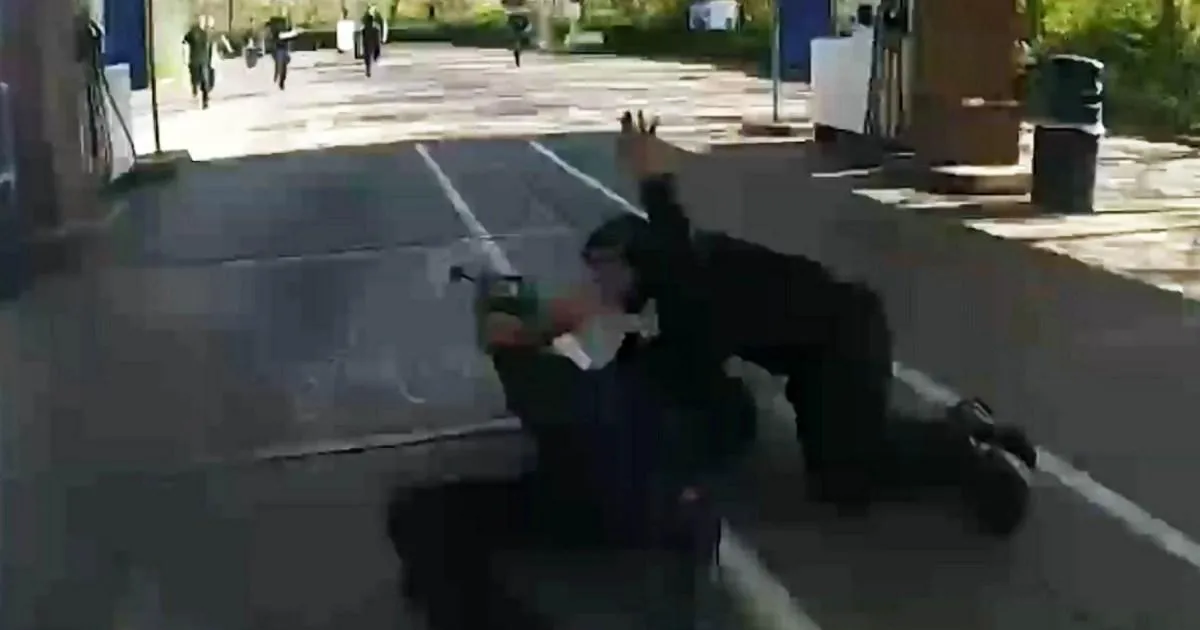
The turning point came when the man poured additional petrol over his head, increasing the danger exponentially. Without hesitation, Thompson sprinted toward him, placing his own life at risk to tackle the man to the ground before he could ignite the fuel.
Other responding officers immediately joined the effort, piling on top of the man to restrain him. Simultaneously, fire personnel sprayed foam over the individual to eliminate any possibility of the petrol catching fire during the struggle.
Recognition for Heroic Actions
Thompson’s courageous intervention has earned him a nomination for the Police Federation National Police Bravery Awards 2026. His superiors have publicly acknowledged the significance of his actions that day.
We are extremely proud of Sgt Thompson, who demonstrated incredible fortitude, empathy, and quick-thinking in his actions that day. It is thanks to him, and the other officers on the ground, that there wasn’t a tragedy that day in Stratford-upon-Avon. He is more than worthy of the Bravery Award.
Acting Chief Constable David Gardner of Warwickshire Police emphasized how Thompson’s combination of courage and compassion prevented what could have become a major public disaster.
Community Impact and Personal Reflection
Reflecting on the incident, Thompson credited his colleagues for their essential role in the outcome. He emphasized that the successful resolution was a collective achievement rather than a solo effort.
I couldn’t have done it without the team behind me – we co-ordinated, we worked together, and it was together that we stopped what could have been a terrible loss of life.
The sergeant expressed his gratitude for being recognized for his work, noting that such acknowledgment validates the dedication shown by police officers daily. He also shared his hope that the man he tackled has since recovered from what must have been an extremely difficult period in his life.
I’m overwhelmed to have been nominated for a Bravery Award – it’s always a good day when our hard work in the police is recognised like this. I hope that the chap I tackled is doing better now – it will have been a very low moment for him, and we hope he’s managed to pick himself back up and get the support he needed.
The incident serves as a powerful reminder of the split-second decisions that police officers make, often with lives hanging in the balance. Thompson’s actions not only prevented a potential tragedy but also demonstrated the human side of law enforcement—combining bravery with genuine empathy for those in crisis.
As the nomination process continues, the community of Stratford-upon-Avon has a chance to recognize one of their own for extraordinary courage in the face of danger. The video footage continues to circulate, offering viewers a glimpse into those critical moments when one person’s quick thinking can change everything.